The Elephant in the Room: Intraboat Communications While Sailboat Racing
By the time we got out of grade school, most of us heard the parable of the elephant: Several people who cannot see encounter an elephant, and to learn what it is, they touch it. But they touch different parts and have different interpretations of what they encounter: The one who feels the tail says, “it’s a rope;” the one who touches the trunk says, “it’s a snake;” and the one who touches its leg says, “it’s a tree.” Only when they share this information with each other do they realize that it is an elephant.
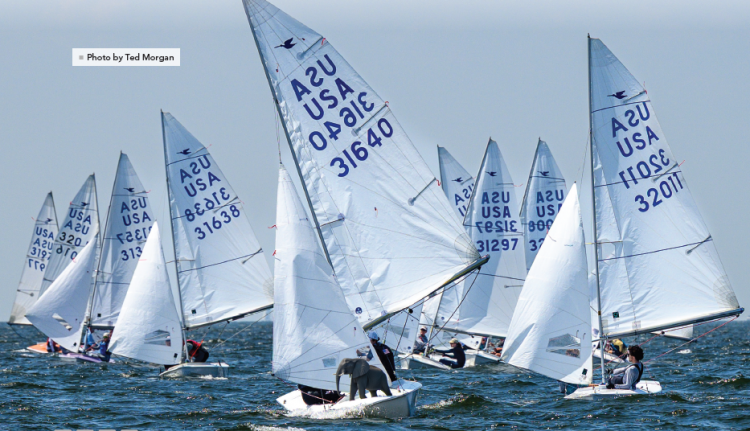 And so it is on dinghies and small boats when the crew is larger than just one person. The sum of the perspectives is key to understanding how things are going and to ensure you’re going as quickly and as smartly as possible. Communicating what you see and feel to each other—proactively—is critical.
Good communication on a boat is not just saying what needs to happen; it’s about communicating the context, the why. This helps the whole team anticipate and respond. For example, if a high priority is keeping your weather hip clear on a downwind leg because the puffs are mostly coming from that side of the course, be sure to communicate that. If the team is in the loop and understands that is important, that helps the crew be more prepared to respond if a boat tries to pass to weather. When sailors communicate well, they stop functioning as a collection of individuals and start operating as one crew.
I recently heard a conversation where someone noted that while trimming the spinnaker, they didn’t tell their boat driver much; the driver just let the spinnaker trimmer know if they weren’t doing it correctly. But that’s not working the boat and sails to maximum effort! If the trimmer notes, “I feel more pressure,” the driver can soak down, increasing progress toward the mark a bit. If the driver says, “I see that we’re a little low of the mark,” the spinnaker trimmer can expect that the driver likely won’t head down if there’s a puff and the trimmer needs to deal with puffs as they come.
The benefits of solid, positive communication are most evident when things get busy. The difference in how teams that do and don’t communicate well respond to changing situations can quickly be measured in boat lengths. A few seconds of conversation can turn several individual observations into a useful picture of the racecourse or identify ways to increase boat speed.
It is easy to think that the skipper is the person who communicates what needs to be done and everyone else just makes that happen. But communication should go both ways. The most successful teams make use of the information and experience of the entire crew. Crews often see a puff before the helm feels it. They have a different view of an approaching competitor. Sometimes the helm has a better perspective on whether you are, in fact, crossing that starboard-tack boat—or they may not be able to see it at all through the jib. If nobody speaks, those observations disappear.
Solid communication does not mean constant chatter. That can be as bad as too little. Finding the right balance for your team is important. Some skippers like a quieter boat than others, and that can work just fine as long as you talk through how you will communicate critical elements (such as that impending starboard-tack boat). Especially during maneuvers, the team should use crisp and clear words: Tacking! Hoist! Ducking!
Communication is particularly valuable on boats where crew members have different levels of experience. A newer sailor may hesitate to speak because they assume someone else knows better. But asking a question or pointing out something unusual can be exactly what the team needs. Experienced sailors should create an environment where useful observations are welcomed, regardless of who makes them.
Ultimately, good, positive communications among the team on a racing sailboat is about more than sharing information. It builds trust. When sailors know that the people around them will speak up, listen, and respond clearly, they can concentrate on their jobs with greater confidence. And that’s fast!
About the Author: Kim Couranz has earned several national and world titles in Laser Radials (ILCA 6), Snipes, and Lightnings. She has also raced J/22s, J/24s, and Ynglings on an international level.


