 Anchored on the Susquehanna Flats
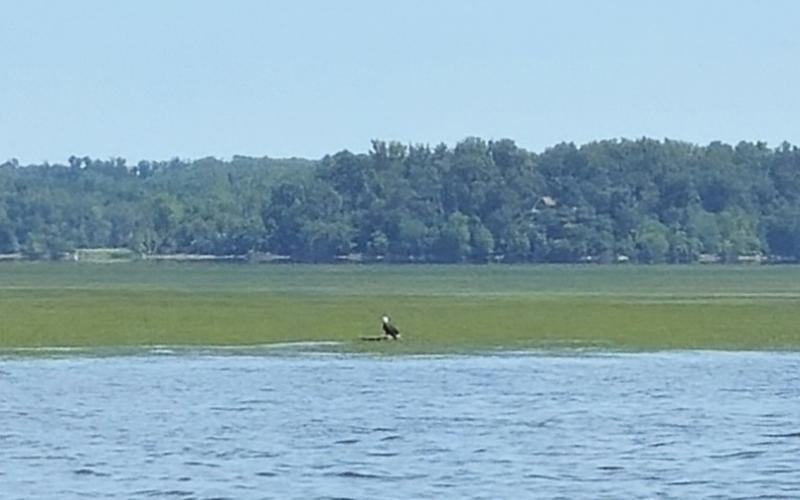 A Bald Eagle, standing on a grounded log
 With no underwater camera, this is the best I can do - 6' of water.
This is my first day of 2026 on my own boat, on the water, for enjoyment. Dobbs and I have worked so hard to get here. Ten months ago, we pretty much put on "boat blinders" and focused our attention on our 76 year-old cottage (as compared to our 60 year-old boat). Structural repairs, additional insulation, new siding, and new windows and doors - we did it all, just the two of us. Now, we're eager to go adventuring.
Today I wanted to visit an old friend: the Susquehanna Flats. Back in 2004, we moved into the aforementioned cottage at Red Point and started sailing Sunfish off the beach. Dobbs and I share a fond memory of ambitiously attempting to sail to Fishing Battery Island, drifting when the wind died, and walking most of the way back home across the Flats, towing our boats like toys. We remember a vast expanse of sandy bottom and little in the way of "weeds" - an easy, if long and hot, walk. A couple years later, we sailed a 22' centerboarder in from the south and were wowed by a verdant meadow of bright green grass and clear water. At some point after that, we started going about every two years, kayaking or dinghy sailing in from the North East River toting masks and fins. Two and a half miles west of Red Point Beach, submerged aquatic vegetation (SAV) appears and the water becomes remarkably clear. The Susquehanna Flats are an ongoing success story in SAV recovery.
Here's a link to a simple yet informative graph of how the SAV has changed over time: Chesapeake Bay Program: SAV Acres and Density - Susquehanna Flats
With our 1966 Columbia 31' sailboat Grace now berthed in Havre de Grace, we'd be approaching from the west instead. Grace draws only 3' with the centerboard up, which makes her a perfect platform for shallow water exploration. Low tide was at noon, so if we did touch bottom, time would see us off. After clearing the marina and hoisting sail, we wafted on a light breeze toward the Flats. If you look at a chart, you'll see two large grass beds divided by a shallow channel. I wanted to anchor close to that channel. Standing on the cabin top for the best view and looking east, a "lawn" of surface floating vegetation beckoned. I watched the water color change from dark olive to lighter olive, then slowly lose its opacity until I was looking at fronds of weed and patches of orangey-gold sandy bottom. When the depth gauge read 6, we dropped anchor.
Dobbs put up the awning and we ate lunch in the cockpit, watching an eagle hunt from a grounded log. In time, we took turns descending the boarding ladder, immersing ourselves in the 80-degree water. Truth be told, it still felt chilly! We donned fins and masks and began to look around. The water clarity was the best I've seen on this western side - about 6' of good visibility. A variety of aquatic plants grew in dense patches - lush, not choked - and were relatively free of heavy sediment, algae, and bacteria. I spotted minnows and shiners, two bluegills, and a crab; meanwhile, Dobbs was discovering a sizeable blue catfish. Empty freshwater clam and mussel shells flecked the sandy bottom. An hour passed quickly and, while we would have liked to keep exploring, chills drove us back aboard Grace to bask in the sun.
Further your understanding:
Life on the Susquehanna Flats - Chesapeake Quarterly, June 2026 • Volume 25 Number 1
EPA - Underwater Grass Comeback Helps Chesapeake Bay
The Comeback at the Head of the Bay: How the Susquehanna Flats Became the Reference Case
By Lowering the Nutrients, the Susquehanna Flats SAV Bed Enhanced Its Own Recovery