Plan Changes, Excursions, and Delights of Bareboat Charter Sailing in Croatia
I’ve been a Chesapeake Bay sailor for 13 years and have two British Virgin Islands (BVI) bareboat charters under my belt. In the summer of 2025, my wife Nicolette and I decided to travel to Italy to celebrate our 40th wedding anniversary. Realizing that Croatia, which was on my bucket list, was just a short flight across the Adriatic Sea from Italy, it seemed like a good opportunity to head there as well for a little messing around on boats. Nicolette agreed (so glad I married her)! Exploring the enchanting islands of Croatia proved to be a winning extension of our celebration.
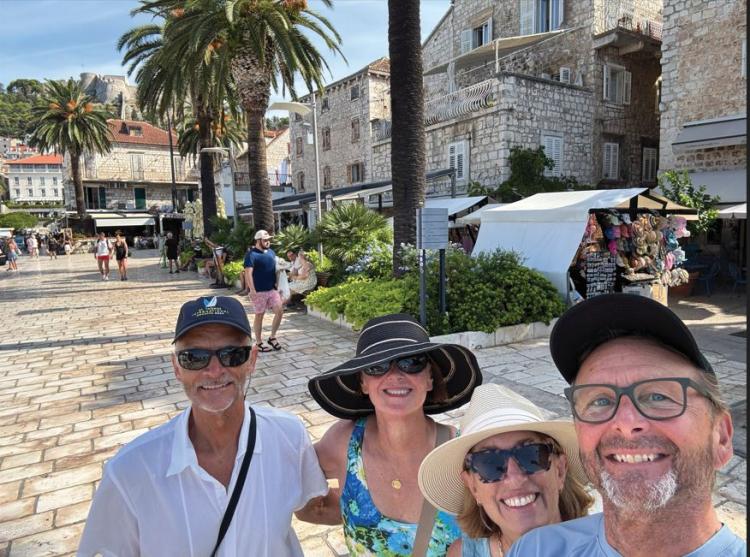
Out of concern that sailing in Croatia would be a “different game” from the BVI experience, we decided to try a flotilla. The benefit is that you get flotilla leaders with vast sailing experience in the region. They’ll help you with reserving the vessel, formulating the itinerary, making marina reservations, docking, and more. We signed up for a week in Croatia’s most popular cruising ground, the Dalmatian Islands.
We invited our good friends Rob and Joanne to join us. They are experienced bareboaters, and Rob is a leader with the USNA Command and Seamanship Training Squadron. We made a strong sailing team.
Docs and a plan change
The documents required for a Croatia charter include the usual passports and such but also an FCC radio license and International Proficiency Certificate (IPC). For the radio license, I bought a study kit and took the exam in Annapolis.
Both Rob and I have Merchant Marine credentials (i.e., a captain’s license), but when chartering in the Med, that license is not worth the paper it’s printed on. The IPC is a better indicator of bareboat training, because it can be awarded only after passing a bareboat charter course, which is offered through sailing associations such as American Sailing or US Sailing. I got the IPC in 2017.
We were all set with plane and hotel reservations when five weeks prior to sailing we received some surprising news: The flotilla had been cancelled!
That left us with three options: scratch the whole adventure, take a captain onboard for a “flotilla” of one boat, or sail by ourselves. After talking with the flotilla company, we felt confident that, with their help in planning it, we could sail the boat ourselves and follow the prescribed itinerary.
Arrival and a plan change
We arrived at Marina Baotić on Saturday, August 23. The marina lies only 15 minutes by car from the Split airport and a 20-minute walk from Trogir, a very popular UNESCO town. The marina is huge and serves as the home base for numerous charter companies.
Our rental contract was with Croatia Yachting. Check-in and check-out days are typically hectic, and our arrival day proved no exception. They kept pushing back the hour that our boat would be ready…until the 5 p.m. deadline had passed. Many people get their boat and hightail it out of there that afternoon to a nearby island and pop open the champagne.
We had planned to head to Otok Solta (eight nautical miles away), where I had reservations at Martinis Marchi Marina. Unfortunately, while we waited for our boat at Baotić, Martinis Marchi called to report that they could no longer hold our reservation. So, we remained for the night in Marina Baotić with the plan to set sail very early the next morning.
Despite some issues with the air conditioning (we were lucky to have moderate temperatures) and a leaky air chamber on our dinghy, we set sail at 6 a.m. the next day on our beautiful (but “experienced”) Jeanneau Sun Odyssey 440 (2021). The 29-nm sail went well. We had blue skies and brisk wind on the beam—speed over ground reaching 8.2 knots. We swung into Rogačić Bay for a quick look at a military tunnel and headed into Vis, where we caught a mooring ball.
A dreamy evening
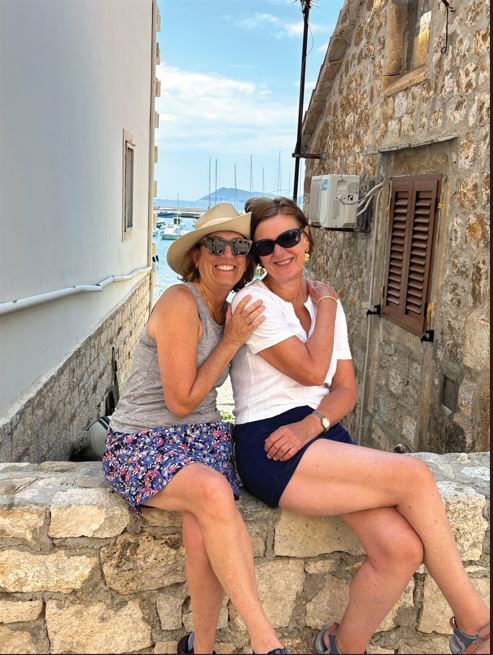
Vis is gorgeous, with its riva (waterfront), tower, and churches. Our main event there was dinner at a winery/restaurant called Konoba Magić. (A konoba serves traditional Croatian food.) The restaurant arranged a van to pick us up at the ferry terminal at 8 p.m. The cuisine at Konoba Magić mostly features the peka (bell), which is a lidded pot with hot coals piled on top. It’s the ultimate slow cooker, and our lamb did not disappoint. As for the wine, the red had an unusually high alcohol content of 15 percent. Good thing we had well-seasoned lamb! It was a dreamy evening, set among the vines in full moonlight.
The next day, in light wind, we motored 10 nm to Komiža, on the western end of Otok Vis. Our early arrival allowed for an easy mooring ball pick-up. We secured the boat, went for a swim, and enjoyed happy hour while watching a parade of other boats vie for the remaining balls. An issue there seems to be that the balls are too close together. We definitely felt threatened by a nearby catamaran. Another one was towing a jet ski, which made it hard to predict how much the swing rate/arc would be affected.
Dinghy tie-up locations in town are not so apparent. After asking around, we finally found a spot at one end of a beach. Komiža is also gorgeous! We strolled the quaint streets while enjoying scrumptious gelato. Dinner was at Konoba Robinzon, which has a good local feel. Next time we’d probably dine on the more vibrant riva at Del Mare.
A land tour with Ivan
On Tuesday morning, we reported to the office of Alternatura in Komiža, a company that offers various types of tours around Otok Vis. Per the original charter itinerary, we opted for a military tour of sites that were restricted during the Cold War. The four of us climbed into a blue Land Rover with our knowledgeable guide, Ivan. Over the next three hours, we bounced along boulder-strewn roads from one spooky Cold War relic to another.
The sites included a subterranean command center at the top of a mountain and cannon bunkers down along the coast. If you visit Vis, you must take this tour to get a true perspective on the island. And it’s really fun!
That afternoon we motored our boat 23 nm along the south shore of Vis to the island of St. Klement, where we had reservations at ACI Marina Palmizana. It’s a prime base from which to visit Hvar, which lies just across the Pakleni Kanal. At Palmizana, my first-ever Med mooring went well, thanks to benign conditions… whew!
Regarding communicating with marinas on the approach: The ACI marinas require that you contact them by telephone or VHF17 at least 30 minutes prior to arrival. We dutifully obeyed that rule but usually heard nothing back—or just a couple of garbled words. You’ll have better success once you get closer. You may have to wait until you see a marinero on the sea wall with his radio in hand. I recommend bringing your personal hand-held VHF so you can converse from the cockpit. Waving and pointing will ultimately clinch the deal. There may be boats ahead of you, which means you’ll have to keep station. (Stern to the wind is best.)
One pleasant surprise at Marina Palmizana is the lovely harbor, just a few minutes’ walk over the hill, called Uvala Vinogradišće. The harbor features a beautiful beach, several attractive restaurants, and a large field of mooring balls out on the water. We’ve decided that if we visit Hvar again, we will try to grab a ball in this harbor, thereby avoiding both Med mooring and Palmizana’s high marina fee (€140).
Due to the harbor’s popularity, it would be wise to arrive early or reserve ahead. If the weather were hot, however, we would prefer the marina so we could enjoy the air conditioning that shore power affords (haha!).
High speed to Hvar
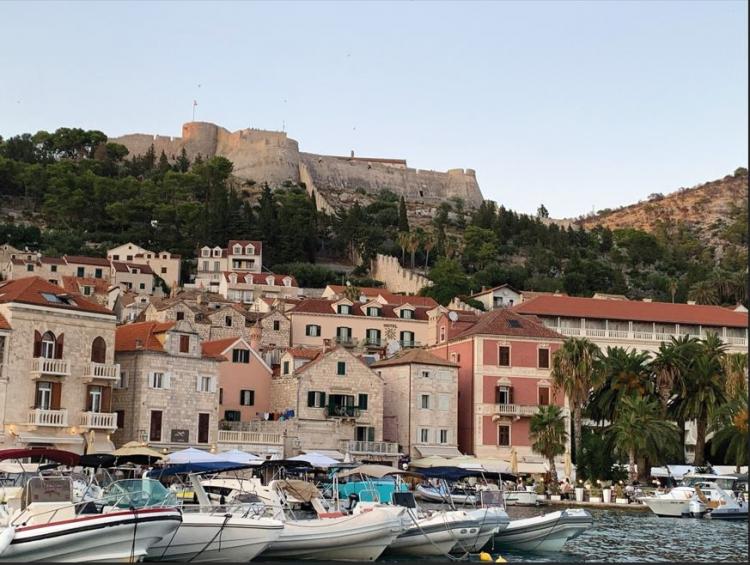
A high-speed water taxi (€20 roundtrip) makes quick work of the 2.5-nm trip to Hvar. It’s an efficient, friendly service, and the views are great on the surprisingly thrilling ride. That evening we had a lovely stroll in Hvar—with about 5000 other tourists. With its wide riva and open squares, Hvar can handle the crowds.
Regarded as the Croatian St. Tropez, Hvar was the most impressive island town we visited. We had a lovely dinner on St. Stephen’s Square at Spice restaurant, which serves a fusion of Asian and Italian food. The next morning, we taxied back to Hvar to explore, take photos, and shop. As we wanted to stick to our schedule, we unfortunately only scratched the surface of this vibrant and fascinating town.
Around noon we set sail for Vrboska (20 nm), which is on the north shore of Otok Hvar. Along the way, we dropped anchor at Uvala Pelegrinska for a dip in the cool water.
The westerly wind picked up once we got into the channel between Otok Hvar and Otok Brač. We enjoyed broad reaching at over six knots for much of the afternoon. Docking at Vrboska was again thankfully free of mishaps.
Vrboska is a small village, uncrowded and charming. It was aglow at night with its riva, restaurants, and a few bridges, which, with a stretch of the imagination, remind one of Venice. There’s also the Fisherman’s Museum and a couple of old churches. We dined at Restoran Ruzmarin, which is closest to the ACI marina.
The owner and his wife made us feel like family, and my grilled fish was outstanding. Even more special was when a regular patron celebrated her birthday: we all sang the Croatian “Happy Birthday,” and cake was offered to everyone in the restaurant.
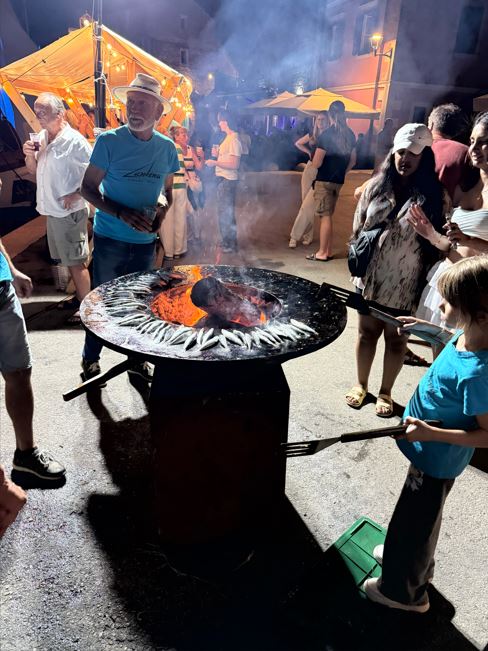
After dinner, we strolled farther into town and happened upon a lively party on the riva. There was a special grill ablaze with sizzling sardines, which even the children were helping cook, and several stalls where ladies were selling the fish. The event was a fundraiser for the local traditional boat club. Even though I had just consumed a whole grilled branzino, I wanted to try a Croatian sardine, done right.
I offered to pay, but the ladies wouldn’t accept my offering. It was delicious! I think we all felt that Vrboska won our hearts and was where we best connected with the local community.
Winding down at Milna
The next day we set sail for Milna (19 nm), which is at the western end of Brač. A good breeze carried us most of the way, broad reaching. En route, we stopped for a swim at Lučice Bay on Brač’s southern shore. This bay is very well protected and large enough for half a dozen boats, and there’s even a military tunnel to explore. Lučice is also where I made my second attempt at snorkeling. I spotted just one yellow fish, accompanied by a few bait-size ones.
At the end of a bareboat charter, the boat must be returned with a full fuel tank (and empty holding tanks). Our intention was to fuel up coming into Milna.
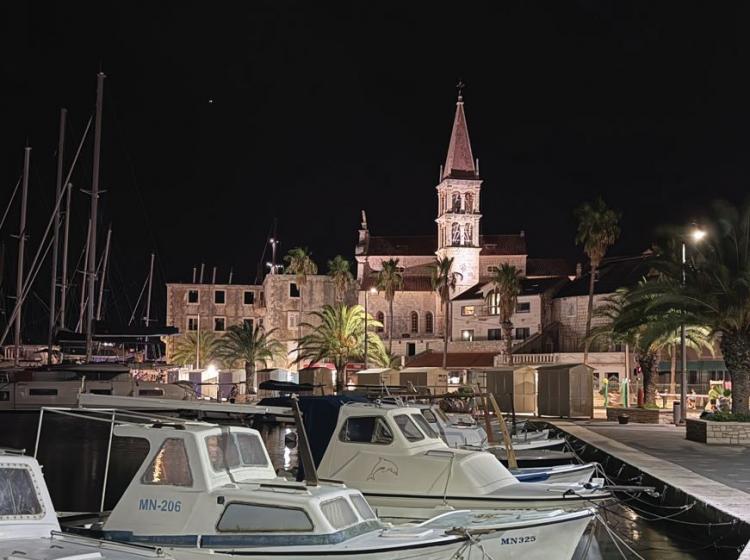
We took our place in the queue behind six boats, while a very thirsty catamaran slugged diesel. Not wanting to arrive too late at the ACI marina, we eventually gave up, thinking we would revisit the fuel dock on our way out first thing in the morning.
By this time the breeze was in the upper teens and blowing across the mooring quay as we approached. The yacht in front of us unfortunately got swept downwind onto other boats as their stern neared the wall.
Mayhem ensued as a crunching sound filled the air. The overworked marineros scurried about like ants to no avail until one of them jumped in a dinghy to push and tow the sailboat into position. Our hearts went out to all of them, as such an experience can tarnish the luster of an otherwise glorious vacation. When it was our turn, we all took deep breaths. Then, Rob brought us smartly in while our crew stayed vigilant with fenders. A big sigh of relief followed!
Milna is yet another scenic Croatian town. (It would take a hundred years to visit them all!) At this point, we unfortunately only had time for a stroll and a bite to eat. Dinner was at Navigare restaurant, which was only a few steps from our stern at the dock. The waitress, Indira, was personable and the food spectacular. I splurged on the Red Scorpion fish (prickly and poisonous until cleaned), which was probably the most delicious (and expensive!) fish I’ve ever eaten.
The forecast for the next and final day of sailing was for 20-30 knots, with severe thunderstorms in the late afternoon. We decided to be first in line at the Milna fuel dock and head directly to our home port of Marina Baotić (17nm), intending to beat the weather. As I was departing the quay in a stiff crosswind, our boat’s port rudder snagged on my neighbor’s mooring line. It caused our boat’s bow to pivot down, and suddenly we were heading toward the same boats that our friends had crashed into the previous evening.
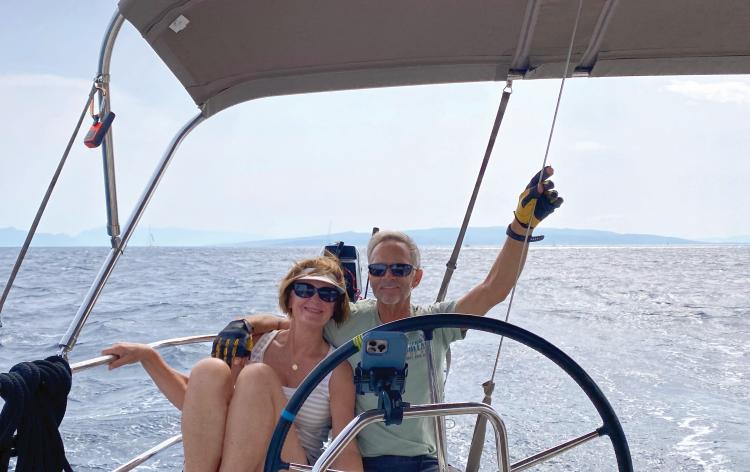
Luckily, I was able to stop and back away while employing the bow thruster, enough so that the mooring line came free from the rudder. The lesson: Bad things can happen to anyone.
Continuing on to the fuel dock and desiring to be first in line… ha! Five other boats had the same idea. We got very good at keeping station while dodging mega-yachts and large ferries in the narrow channel. After fueling, we made great time to our home port, running under jib alone. (The wind never exceeded 23 knots true.)
At Marina Baotič, after docking, our vessel had to undergo a thorough damage inspection, including by a diver examining the hull. We passed! That afternoon, before the storm arrived, my wife and I hustled over to the much-touted town of Trogir.
Time for just one more stroll with gelato, followed by beer on the riva, taking in the magical scene. This final treat put a smiling emoji and two thumbs up on an incredible Croatian sailing adventure.
About the author: When not sailing on the Chesapeake Bay or on the Potomac River with the Sailing Club of Washington, Bob Oppelt is principal bass with the National Symphony Orchestra.


