Considerations for Finding the Right Offshore Sailing Vessel
Sailors often dream big, inspired by stories from those who have sailed around the world. These accounts can offer practical guidance as well as motivation for pursuing offshore adventures. In part two of our Offshore Series, I continued my conversation with Andy and Heej Wescoat to learn how they chose a boat to realize their circumnavigation dream (find part one here).
Initial research
Once the Wescoats decided they wanted to join the World Atlantic Rally for Cruisers (ARC) to sail around the world, they began reviewing types of boats from previous rallies. They also attended boat shows and looked at new yachts. Knowing they would primarily doublehand, Andy and Heej wanted a sailboat that they could confidently sail together.
After 10 years of offshore racing on their J/109, they wanted a fast boat. Their broker, who was very knowledgeable about bluewater boats, suggested heavier yachts for ocean crossings. Together, they narrowed their list to focus on Oyster, Hylas, Outbound, and Farr.
Preliminary criteria
The Wescoats shared the following search criteria with their broker:
Length: They targeted 45 to 50 feet, with the ability to comfortably sleep six. For the right boat and price, they were willing to go larger but did not want higher operating costs.
Performance: While they would mostly be tradewind sailing, they still preferred a boat that would also perform well going to weather. Andy was initially concerned about in-mast furling but admitted that his bias was not based on experience. They targeted a maximum draft of eight feet as recommended by the World Cruising Club. They assumed they would acquire new sails.
Comfort: Sailing comfort and performance were more important than below-decks comfort. They wanted to avoid the downwind rock-and-roll motion that was typical of old International Offshore Rule (IOR) boats.
Ease: The boat must be relatively easy for two people to sail.
Galley: Andy said, “My biggest concern about extended cruising is what are we going to eat?” As offshore racers with a “long” race of 300 miles, they were accustomed to pre-cooked meals that were reheated while underway. They did not know what to expect for a galley and its associated systems for circumnavigation.
Head: Heej wanted, “Everything associated with the head(s) to be impeccable and functioning perfectly.”
Condition: They didn’t mind buying new sails or electronics, but wanted to avoid any real system issues, including engine, generator, watermaker, and plumbing.
Timing: They wanted to purchase a boat in early summer 2021, allowing them two seasons to prepare before the Salty Dawg Rally in November 2023.
Honing their criteria
Comparing boats, the Wescoats honed their criteria further:
Speed and comfort: After comparing a variety of designs, Andy reflected, “As a kid, I loved the book, “Dove,” by Robin Lee Graham. He sailed around the world in a 24-foot boat. I’m long past that! There is a lot to be said for comfort and speed. We wanted a boat that could achieve 200 nautical-mile days in a decent tradewind. That goal drove us toward longer waterline lengths.” They also wanted three cabins, with one assigned for storage.
Weight and draft: Both Andy and Heej are engineers and competitive racers, so they view weight and draft as a balancing act. They created a spreadsheet with a series of key ratios: sail area to displacement, ballast to displacement, displacement to length, etc. There are rules of thumb for each ratio regarding performance and weight. The spreadsheet made it easy to compare designs and boats they had sailed previously. Online PHRF and ORC ratings assisted with performance insights, which were used to short-list several designs. As they narrowed in on the Farr, they reached out to Britt Ward at Farr Yacht Designs who sent polars and build certifications that helped finalize their decision-making.
Finding the right boat
With refined criteria in mind, the Wescoats connected with boat owners of targeted brands. Andy reached out on LinkedIn to John DiMatteo who had completed the World ARC in 2018 on his Farr 50 Madrigal. Within a few minutes Andy received an enthusiastic response, “You’re going to love doing the ARC,” along with recommendations for preferred vendors in Annapolis. The ARC community was already proving to be a valuable resource.
Shortly thereafter they found a 2001 Farr 50 Pilothouse in Mystic, CT. They fell in love, made an offer, did a speedy and satisfying sea trial in 15 knots of wind, and began their earnest preparations for ARC.
Readying the boat
The Wescoats described buying the boat as “the easy phase.” “Readying Kaja for a 30,000-mile voyage is an equal task, comprised of budgeting, scheduling (especially long lead items), selecting gear, and much more.” Fortunately, they found many helpful resources, including World ARC and the network of Farr 50 owners.
They emphasized, “The most valuable resources are the teams you enlist to get the boat ready. Fortunately, Annapolis has many excellent vendors and contractors with great experience.”
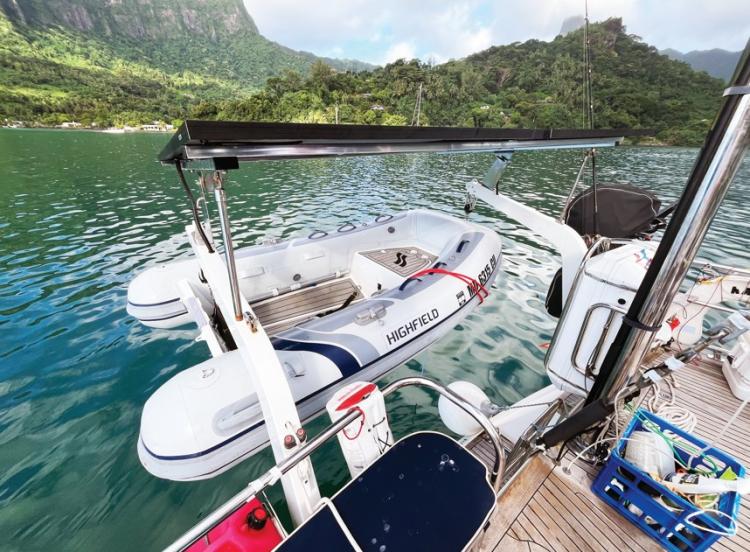
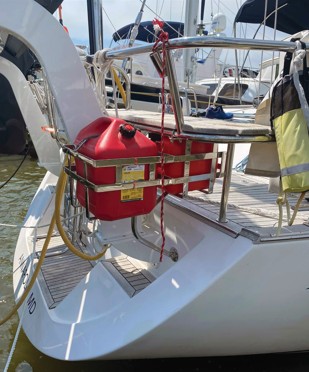
Their survey was just a starting point for a work list. They prioritized replacing thru-hulls, 1000-hour engine service, new sails, new standing and running rigging, hydraulics overhaul, and a new rudder. They added dinghy davits, upgraded the hot water heater and freshwater pump, and fabricated custom storage for dinghy fuel and LPG tanks. They also swapped a water tank for a fuel tank, since they had added a watermaker.
The Wescoats understood the importance of power management, both demand and production. They added solar panels and reconfigured their power so that they could connect to 50-Hz shorepower systems (used by most countries). They also upgraded the main battery charger/inverter and battery monitoring system.
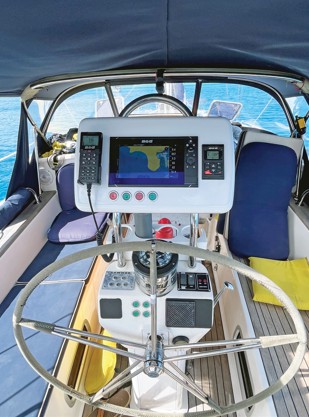
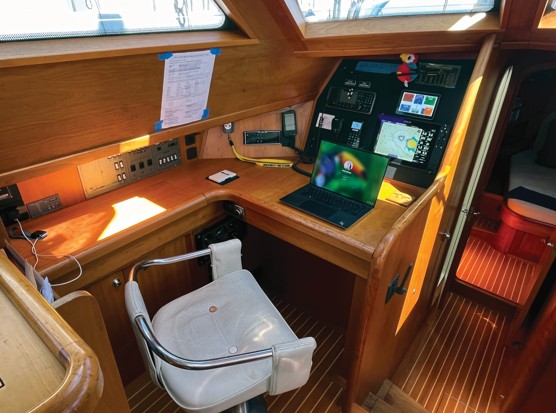
Navigation and communication were additional investments. Despite functioning instrumentation, they did a complete replacement with new B&G instruments and installed an SSB radio and Iridium satcom system; though they eventually added Starlink when that technology became readily available.
Reflections after circumnavigation
As I wrapped up my interview, I asked about the outcomes of some of their boat selection decision-making.
Andy replied, “Kaja lived up to her speedy reputation, frequently hitting 200 nm days. Admittedly, we pressed hard. Initially, we only flew the kite in daylight hours; it wasn’t long before we had it up all night. Our mindset: once we departed a port, we didn’t want to linger. It was all about getting to the next destination. And, yes, we are still competitive.”
He added that the ability to stay secure in the cockpit in a big sea was also important. “At first, I wasn’t thrilled with the idea of in-mast furling. Now, I am a big fan. It’s so easy to reef singlehanded. Throughout the night, we were able to make changes without waking one another.”
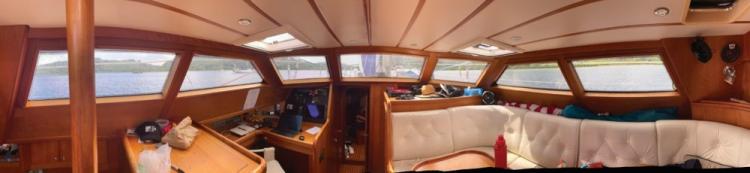
Below decks, the Wescoats found they really enjoyed having a pilothouse. “This was our home for 19 months. Having light and visibility, particularly in exotic anchorages, was wonderful.”
When describing how they feel about their chosen vessel, Andy and Heej shared a favorite quote by 19th-century poet Robert N. Rose: “Ships are the nearest things to dreams that hands have ever made, for somewhere deep in their oaken hearts the soul of a song is laid.” Indeed.
About the author: Captain Cheryl Duvall is a USCG Licensed Master Inland 100 GRT, and president of the Chesapeake Area Professional Captains Association (CAPCA). She enjoys helming Watermark’s Miss Anne in Annapolis. Email her at [email protected].
Find more cruising stories


