Four Years and 10,000 Nautical Miles of Singlehanded Cruising
In part two of this two-part series, I continue my conversation with solo sailor Julie Roberts as she reflects on the joys and challenges of cruising aboard At Ease, her Leopard 44 catamaran (find part one in our June issue and at spinsheet.com). With four years and over 10,000 nautical miles at the helm, Julie shares insights gained from experience.
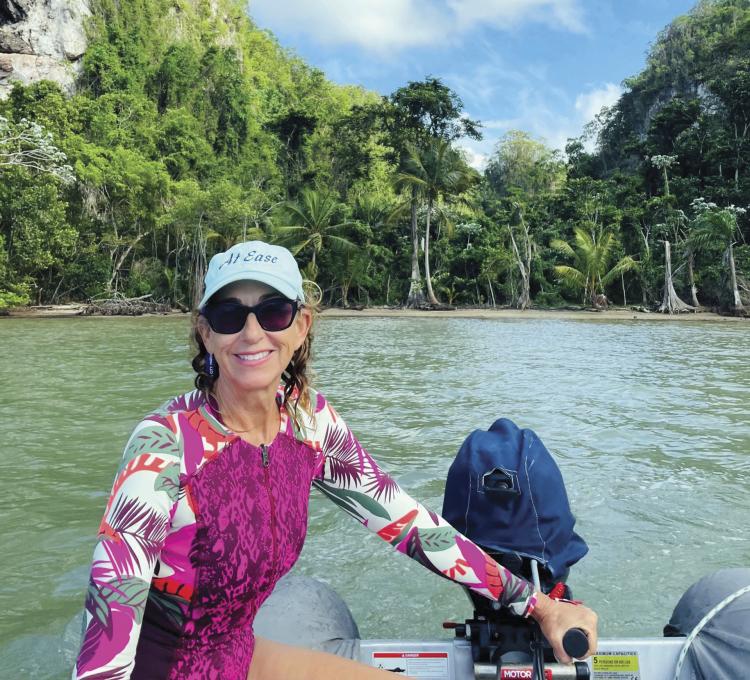
Looking back, what stands out?
There is a steep learning curve for new cruisers, about 12 months. I really did enjoy that first year though along the US East Coast and the Bahamas. I loved transiting the New York City Harbor and East River, twice! Anchoring near Ellis Island was a thrill with its spectacular view of the city. Most memorable was sailing my own boat into Annapolis. Having my parents and fellow Navy graduates onboard (Ned ’56 and brother Derek ’83) made it extra special.
Any destination favorites?
I’ve truly enjoyed every place I’ve landed: Dominica and the Dominican Republic for unspoiled beauty, St. Martin and Martinique for food and culture, and the gorgeous Grenadines for sailing. I’m partial to Grenada after spending two hurricane seasons there. It’s a beautiful island where cruisers become friends, share information, and make big plans. I’ve stayed connected to these friends throughout the Caribbean and beyond.
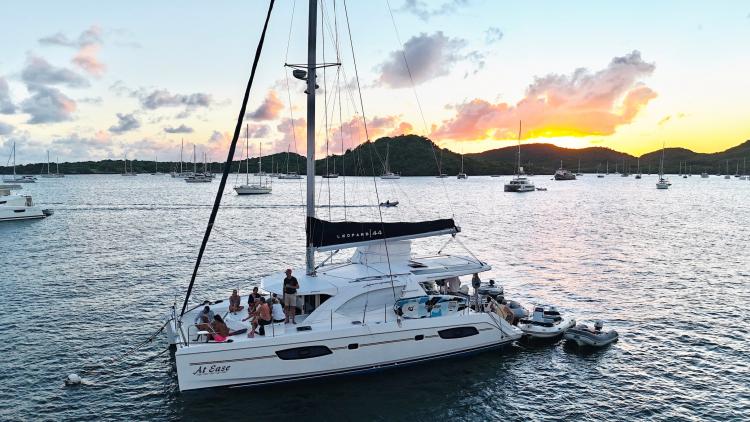
How do you manage crew and travel logistics?
I’ve had dozens of crew aboard, including family, US Naval Academy classmates, grad school buddies, and new friends I’ve met through sailing. Some are vacationing; others crew the boat. Explaining things repeatedly can get tiring. I joke that each crew advances from C- to A+ and then I get the next C- crew and start over.
Travel logistics can be quite challenging. In 2023, with the July 1 hurricane deadline approaching, I had to sail 1500 nautical miles from the Bahamas to Grenada, much of it upwind, and all of it unknown to me. Balancing crew availability, skills, and arrival/departure airports was tough. I followed the “thorny path” guide, but every day required new decisions. Riding out tropical storm Bret in Marigot Bay, St. Lucia, caused a delay, resulting in the early departure of my final crew. I sailed solo into Grenada on June 30, shedding a few tears of joy, relief, and pride. I just wanted a hot shower, a good meal, and to sleep for three days straight!
Have you sustained injuries on the boat?
One night in the Exumas, my dinghy davits broke, and the entire structure fell on me while I was hooking up the dinghy. It was a bad situation. A neighboring boat came to help. I likely had a slight concussion in addition to head lacerations and bruised shoulders. I took it easy for a few days. As a solo sailor, I worry most about slipping, falling, breaking a bone, or going unconscious, so I’m very careful. To stay flexible and nimble for boat work, I swim and do yoga.
Any illnesses for you or your crew?
Luckily, no crew illnesses other than mild seasickness or sunburn. My serious illness occurred last fall when I returned to Santa Marta, Colombia, where At Ease had been for the summer. While prepping for Panama, I began experiencing flu-like symptoms just as my brother Brian arrived as crew. Four days later after worsening conditions, we headed to the ER. I was diagnosed with severe Dengue Fever and admitted to the ICU. I spent a week in the hospital and, according to my brother, “almost died.” I recovered but had lost significant weight and muscle and was so weak that I had to fly home to stay with family for two months.
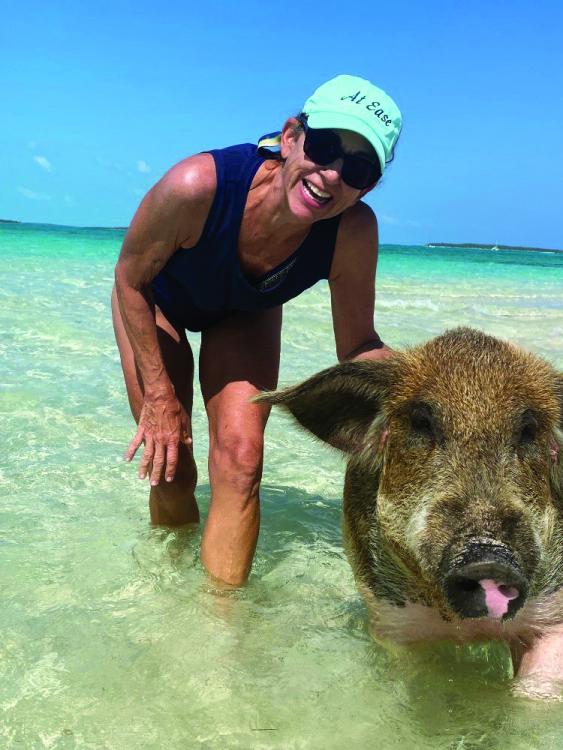
Do you feel safe as a solo female cruiser?
I’ve felt quite safe throughout the Caribbean. People are kind, helpful, and proud of their islands. I do lock up if I’m alone in a remote anchorage. If uncomfortable at a dinghy dock at night with people hanging around, I may mention “getting back to my husband” on the boat. The only time I felt harassed and unsafe was by a fellow American sailor. There is a Caribbean cruisers safety network (CSSN) where reports can be made. A few boats have had very upsetting incidents, but those are rare. The most common theft is the dinghy/outboard, so I raise my dinghy every night and always lock it at a dock.
Any reactions to you as a female singlehander?
I’ve only met two other solo women in my travels. I meet a fair number of solo men, but most boats have couples and some families. In general, people are very respectful and helpful, but there are awkward and funny moments. On the islands, local customs officials often assume my male crew is the captain. In one country, I was challenged multiple times—”Capitana?!” Finally, they understood, clapped, and shook my hand. Of course, I told friends and family to now address me as “Capitana.”
When and why do you take breaks from the boat?
After four-plus years of life aboard, I need time away for better balance. I’ve taken the past two summers off (hurricane season) for family events, weddings, and other travel. I also attend to practical matters such as medical appointments, finances, and taxes. It’s a nice break from being “on” all the time and watching the weather, planning passages, researching anchorages, and constantly monitoring every noise or fixing things. I return to At Ease with renewed energy and excitement for the fresh season.
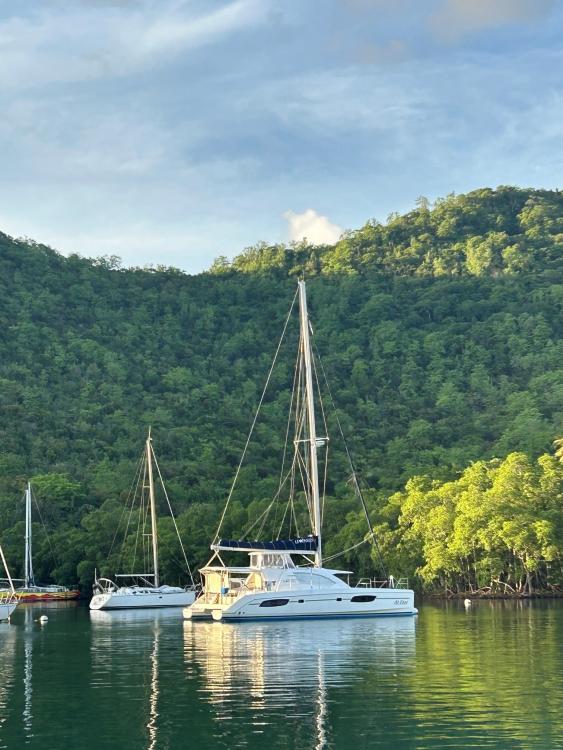
Do you cruise on other boats?
This spring I crewed across the Pacific Ocean with a family on their Leopard 46 catamaran: one week from Panama to the Galapagos, where we spent three weeks, and 20 sailing days to Hiva Oa, French Marquesas. Three of us stood watch with five-hour day shifts and three-hour nights. We had a few rough days and squalls, but mostly beautiful spinnaker days with the trade winds behind us. We did not see another vessel until day 16 (cargo ship). We did see a stampede of 500 dolphins, a ghost ship, and entire trees floating by. Pelagic red-footed boobies entertained us from the bow. We caught and ate mahi-mahi and yellowfin tuna. At night, we were awed by shooting stars and the Southern Cross. I’m so glad I did it!
What’s next?
I plan to continue exploring Panama. I enjoyed the gorgeous San Blas Islands this past spring before crossing the Pacific. After fall boat work, I will head to Bocas Del Toro. The next goal is transiting the Panama Canal on my boat, a big and expensive decision. Crossing into the Pacific brings new challenges, but my plan is to work up the coast of Central America, eventually to the Sea of Cortez, Mexico. People spend years there, and Jacques Cousteau dubbed it “the aquarium of the world.” I’m excited to explore a new region and be closer to home in California, but I will miss the beautiful Caribbean.
Any parting words for other cruisers?
I’ve never regretted my decision and encourage anyone considering this lifestyle to go for it! Be ready to work hard at every turn, but the rewards are infinite.
Find part one of this series.
About the author: Captain Cheryl Duvall is President of the Chesapeake Area Professional Captains Association (CAPCA). You may see her at the helm of her Gozzard 44 Belle Bateau or on Watermark’s Miss Anne in the Annapolis Harbor. Email her at [email protected].


