The Panama Canal, an Interesting Journey for Cruising Sailors
We weren’t really sure what to expect transiting the Panama Canal on our cruising boat, Kaja, a 2001 Farr 50 pilothouse. From start to finish, we saw a wide variety of technical marvels, massive ships, and natural beauty. The locks themselves were like Thomas the Tank Engine for adults—trains, locomotives, ships, tugs, pilot boats—all engaged in this great choreography.
Departing Shelter Bay Marina at 4:30 a.m., we picked up our advisor (sort of a small craft pilot) outside the marina and proceeded toward the Gatun Locks, passing under the Bridge of the Atlantic as the sun began to rise. The howler monkeys made this incredibly eerie cacophony as we motored closer to the jungle area along the canal.
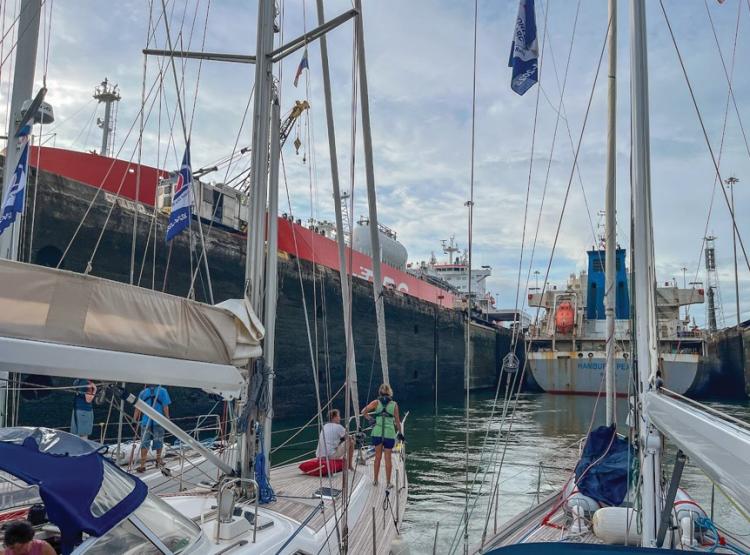
As we approached the lock, we rafted up with two other sailboats to form a ‘nest’ of three boats. The two outside boats (one of which was us) had lines to keep the nest in the center of the lock and big fenders just in case. We followed the Hamburg Pearl, a dry bulk carrier, into the lock. Line handlers ashore threw down messenger lines and hauled up our larger lines. The lock is 110 feet wide, and our nest was probably 45 feet wide, so there was a good distance to the wall.
Secured in place, the massive lock doors behind us began to close. To conserve water, they move water from one lock to the next. The process begins slowly, and the pumps kick on, transferring massive amounts of water into the lock, swirling all about. As we were lifted, line handlers on our boat took up the slack.
While we held our nest on the center manually, small train engines held the Hamburg Pearl in the center of the lock; hence, my Thomas the Tank Engine analogy. Once we reached the new level, the lock opened in front of us and the Pearl moved forward, followed by our nest.
A series of three locks dating back to 1914 lifted us 85 feet. It is not a fast process, but it is a massive one when you think about the size of the ships, massive amounts of water, huge amount of engineering, and sacrifice made by those who built the canal. Remarkable.
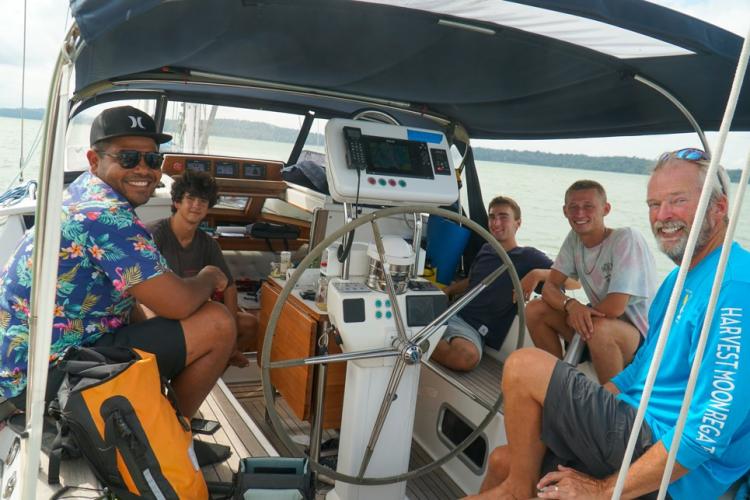
Once we departed the third lock, our nest broke apart, and we proceeded 21 nautical miles to Gamboa where we would raft up for the night. The beauty of the lakes along the way was truly surprising. I guess I had imagined something more akin to the Houston Ship Channel. (Not that I didn’t love our years sailing there.) The lakes were created by flooding the Chagres River. Once peaks of the mountains, the islands are a treasure of wildlife, one occupied by the Smithsonian Tropical Research Center. Along with the natural beauty are, of course, all the ships transiting the canal. And crocodiles; yup, no swimming here.
We had to spend the night in the lake in order to get a position in the transit heading down to the Pacific. Good fun. Our group of three sailboats tied up to a massive mooring buoy, and our advisors departed. And, of course, the floating party began… a moveable feast of beer, Prosecco, wine, gin and tonics, rum punches, and appetizers to boot. We also finished the last of the frozen Texas chili with cheddar cheese, sour cream, rice, and tortilla chips, but the Fritos were long gone!
Gamboa is a major hub for the canal. A half dozen miles north of the locks to the Pacific, it is a center for tugs, pilot boats, and dredging equipment. A train moves along the shore carrying containers back and forth to terminals in Colon and Panama City (again, like a scene from Thomas sans the Fat Conductor).
The next morning began much the same way, albeit at a much more civilized hour. Our advisors met us before noon, and we headed down to the Pedro Miguel lock.
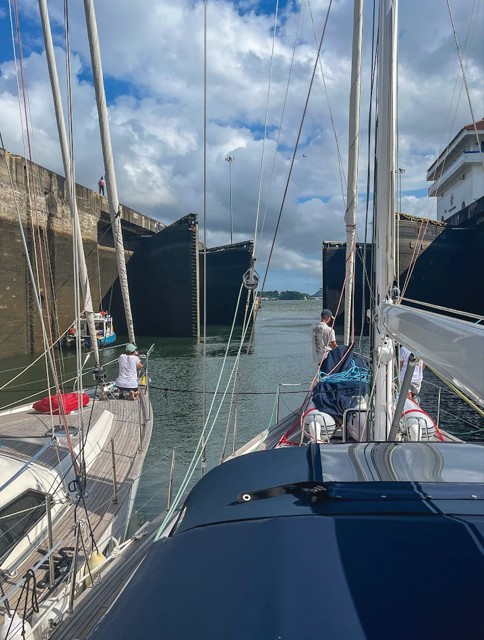
In similar fashion, we formed our nest and entered the lock. This time we entered the lock ahead of the Pacific Jasper, a chemical tanker. The clearance for the tanker on each side could not have been more than a foot or two. Amazing. Taking direction from the pilot onboard the ship, the little locomotives responded with a series of bells and held him centered in the lock. And we dropped down 85 feet to the Pacific.
In a mere 36 hours we crossed a continent and moved from one ocean to another. It sure beat sailing around Cape Horn!
Planning Tips
- Water shortages are curtailing traffic through the canal. An agent can help you secure a spot on the schedule and can provide you with the required large fenders and long lines that will reach up to the walls of the canal.
- Even though you may be rafted together, each yacht needs a skipper and four line handlers, as well as an advisor provided by the Canal Authority.
- Both sets of locks have online web cams so that friends and family can follow your transit.
- If you’re headed to the Galapagos Islands, be sure your hull bottom is spotless. With any growth, officials in Galapagos may require you to head 60 nm offshore with a diver to have the bottom cleaned.
- Read David McCullough’s excellent history of the canal, “The Path Between the Seas: The Creation of the Panama Canal.”
By Andy Wescoat


