Sailfaster: A Conversation with J/105 Racer Angelo Guarino
Sailfaster Podcast recently sat down with Annapolis sailor Angelo Guarino, skipper of the J/105 Crescendo, to discuss how to succeed in fiercely competitive one-design racing. Here’s an extract:
Sailfaster: You’re consistently at the sharp end of a very competitive J/105 fleet in Annapolis. How did you manage that?
Angelo: I realized there are really three parts to sailing faster: the boat, the skipper, and the crew. If you want to improve, you have to honestly ask yourself which one is holding you back. Early on, I decided to take the boat out of the equation as much as possible. I became obsessive about the details—clean bottom, fair foils, sail condition, weight placement, rig tune. If the boat is right, you can focus on improving yourself and your team.
You’ve said before that small improvements add up over time. What do you mean by that?
When I first started racing, we weren’t very competitive, so I started asking, “What can we change?” We began experimenting with sail trim, reefing earlier, cleaning the bottom more often—just little things. Every small improvement moved us slightly forward in the fleet. That lesson stayed with me. Sailing faster usually isn’t one magic fix. It’s dozens of incremental gains layered together over years. Most sailors leave speed on the table because they stop questioning what they do automatically.
You’re known for your focus on preparation. How important is boat setup?
Hugely important, especially in one-design racing. If your boat can’t hold a lane off the starting line, you’re in trouble before the race even begins. One thing sailors underestimate is underwater shape. Your keel and rudder are wings moving through water, and water is a much denser medium than air. Small imperfections matter. I spent nearly 90 hours re-templating my keel this year to make sure it matched the class templates properly. Afterward, I could feel the difference immediately—the boat tracked better and held its lane more effectively. You don’t have to become obsessive to that degree, but sailors should at least make sure their foils are fair and their bottoms are smooth and clean.
You’re known for being meticulous about weight placement. Why does that matter?
Weight matters everywhere, but especially in the ends of the boat. I spent years as the fleet measurer telling people to remove unnecessary gear, move batteries forward, and minimize weight wherever possible. Every extra pound affects how the boat moves through waves and accelerates out of maneuvers. A lot of sailors are looking for advanced tuning secrets while carrying things onboard they don’t need.
What about crew work? You’ve built a loyal team over many years.
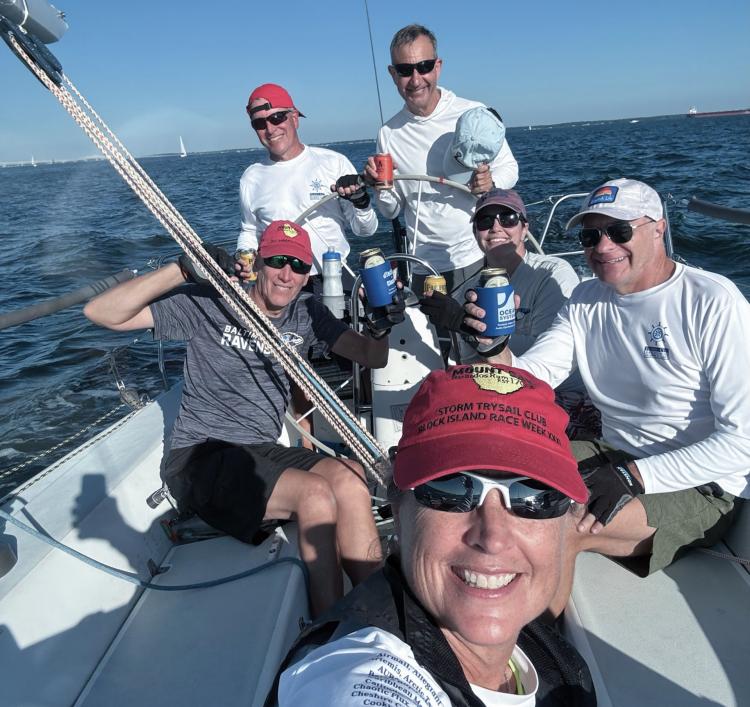
I sail with friends, not hired guns. That’s important to me. I also believe that if people are giving up weekends and putting their energy into your program, you owe them a competitive platform. We try to create an environment where people can improve together. No screaming, no demeaning people—just learning. Everyone on the boat is invested in getting better. Wednesday night racing is a big part of that. We use those races not just to compete, but to rotate people through positions and develop depth onboard.
One final tip for sailors trying to improve?
Pay attention to feel. Every boat has moments where everything suddenly clicks and the boat feels effortless—like it’s gliding or on ice skates. I call it “elevator mode.” When you feel that, remember it. Chase it. That’s the boat telling you you’ve found something good.
Listen to the full episode on Sailfaster wherever you get your podcasts or on YouTube.


