Winning Starts: A Repeatable Process That Works
On the Chesapeake Bay, races are often decided in the first five minutes, more often than not, right on the starting line. Short courses, shifty breeze, and current all magnify the importance of getting off the line clean, fast, and in control of your race with options to execute your game plan.
The good news? Consistent great starts aren’t luck; they’re the result of a repeatable process. The best teams follow a disciplined routine before every race, allowing them to execute under pressure and adapt to changing conditions.
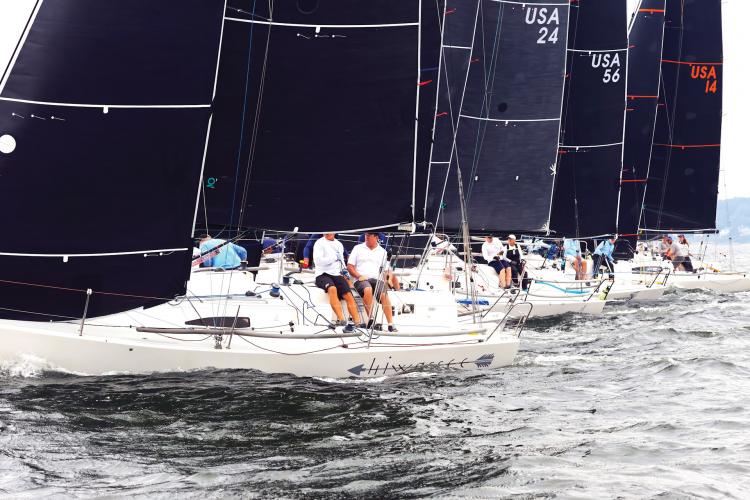
Build your prestart routine
Every strong start begins well before the sequence. Your prestart routine should eliminate uncertainty and give your team confidence in the plan.
Start by pinging the line accurately at slow speed, making sure the bow is square to the line. Then, sail the line to determine bias, understanding whether the pin or boat end is favored, or if it’s square. Also useful: sail through the line and check your pings and starting device for accuracy. Have the bow person drop their arm when you sail through the line as the back of the boat reviews the meters to the line.
On the Chesapeake, current is always a factor. Check it at both ends of the line. It’s not uncommon for one end to have significantly more pressure or relief, which can override a slight geometric bias. If you’ve decided to win an end, it’s critical to understand how the current will affect your normal laylines.
Finally, sail the laylines to both ends so that you know exactly where they are during the sequence. This becomes critical in the final minute when decisions happen fast. Often you can use a land sight to confirm where you are on the pin and boat laylines.
Practice before it counts
One of the biggest mistakes teams make is skipping practice starts. Even one or two short practice runs before the first race can dramatically improve timing and coordination.
These don’t need to be full sequences; two- or three-minute drills are enough. The goal is to sync up the helm, trimmers, and bow team with the conditions of the day. You’ll dial in acceleration, confirm settings, and establish your minimum controllable speed. That “feel” translates directly into confidence and muscle memory when the real start begins.
The four keys to a great start
At its core, a successful start comes down to four simple principles:
the 4 B’s:
- Be on time.
- Be moving.
- Be on starboard.
- Be at the favored end.
They sound simple, but executing all four simultaneously—under pressure, in traffic—is what separates top teams from the rest of the fleet. The goal is to hit the line at target speed, target heel, and a few seconds after the gun.
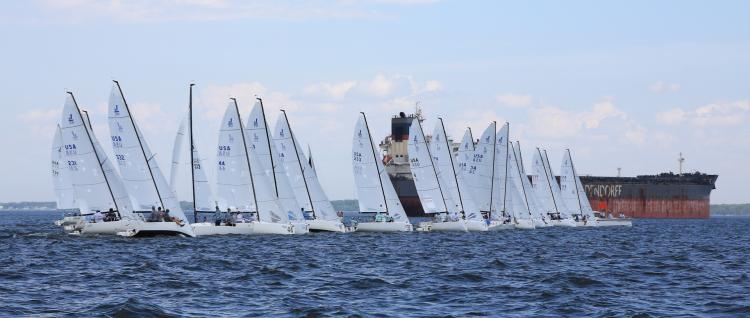
Choose the right starting spot
Where you start on the line should reflect both the conditions and your team’s strengths. Pin-end starts can be powerful, especially when the left side of the course is favored. But they’re high-risk, particularly when there is pin-end bias. Crowding, limited escape options, and the need for precise timing make this a tough place to execute consistently. The reward, however, is real: the pin boat can put the bow down and easily sail targets, while boats tight to windward must sail higher and slightly slower to maintain their lane.
A more reliable option in many fleets is just up from the pin: the “middle pin” zone. It offers a balance of opportunity and flexibility, allowing you to access the left side while still keeping lanes open. Many regattas are won by teams that can consistently get off the line clean in this area, since it gives them options heading up the all-important first beat.
Mid-line starts are the most conservative. They’re often less crowded and give you the ability to play shifts, but they require confidence in your boat speed and your ability to be very close to the line at the gun. Utilizing starting software or GPS-based starting units, such as the Vakaros or Velocitek, can really help identify how far back you are from the line and eliminate mid-line sag.
Toward the boat end, similar tradeoffs apply. The boat end can be heavily favored in certain conditions, but it comes with congestion and risk. Starting just down from the boat often provides a safer, more repeatable approach while still protecting the right side.
The key is aligning your starting position with your race strategy. Don’t just chase the bias; start where you can execute cleanly. I’m a strong advocate for starting in less dense areas of the line when the bias is less than 10 degrees, especially in larger fleets where sailing in clear air for the first five minutes is essential to reaching the top third of the fleet at the first mark.
Own your lane
The ultimate goal off the line is simple: sail straight as long as possible in clear air. To do that, you need a lane: a cushion to leeward that allows you to put the bow down and accelerate without being pinched. Most of your prestart positioning should be focused on creating and protecting this space.
A strong start isn’t just about hitting the line at speed; it’s about setting up the next five minutes. If you’re forced to tack early or sail in disturbed air, even a “good” start quickly unravels.
Refine your prestart moves
Great starters have a toolbox of moves they can deploy depending on the situation. A late leeward approach can create a strong lane just before the gun. Aiming at approaching port-tackers can force them to tack early, opening space for your final setup. Double tacks, when executed cleanly, can help reset positioning if you get squeezed.
For many heavy keelboats, a “high kill” technique is especially effective: sailing just below head-to-wind with main and headsail trimmed, maintaining minimal boat speed while keeping the boat fully loaded on its foils and ready to accelerate instantly.
These are not one-size-fits-all tactics. The key is practicing them so that your team knows when and how to use each one.
Teamwork makes the difference
Starts are a full-team effort. The middle of the boat manages time, calling the sequence clearly and consistently. The bow provides critical spatial awareness and helps guide the boat to the line. Trimmers focus on maintaining target speed and mode, adjusting instantly to changes. The helm and tactician must stay aligned, balancing positioning, timing, and the bigger strategic picture.
Clear, concise communication is essential. In the final minute, there’s no room for confusion.
Do the work; get the results
On the Chesapeake, where passing lanes are limited and shifts can be subtle, the start often dictates the race. The smaller the course, the greater the impact. The teams that win consistently aren’t guessing. They’re prepared. They’ve pinged the line, checked the current, practiced their timing, and committed to a plan. Most importantly, they stay focused on the big picture. Avoid getting drawn into small prestart battles that don’t serve your overall strategy.
Put in the work before the gun, and your results will show. Good starts aren’t magic; they’re a process. And it’s one you can master with practice and discipline.
~By Scott Nixon of Quantum Sails
Questions? Email [email protected].


