How Improvement in Racing Isn’t Always Measurable by Numbers
A reflection on the ILCA 6 Master World Championships hosted by the Nautical Club of Kalamaki in Athens, Greece.
The final day of the 2026 ILCA 6 Masters World Championship never really began. From the moment I walked outside that morning, I could feel the difference in the weather. The air wasn’t just hot; it was heavy, humid, and still. We postponed onshore for an hour, then two. All the sailors puttered around the yard, jumping from shady spot to shady spot. The wind never filled in. All of a sudden, this event came to an unceremonious end, racecourse battles left unfought with friendly rivalries dissipating, lost to the soft fluttering of crisp racing sails being dropped for the last time.
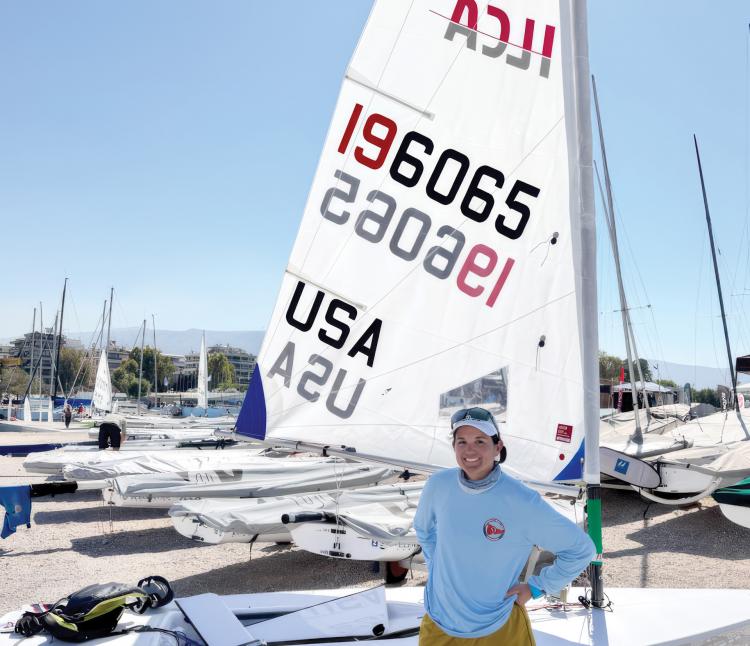 Sailing has a way of doing that: ending not with a finish, but with a question mark. There’s always another race, another regatta, another opportunity to best your competitors.
I finished the regatta tied on points with a competitor from France, winning the tiebreaker by a single better result. We congratulated each other and admitted we would have preferred one more race to settle it outright. Another competitor, just a few points out of third place “woman class” never got the chance she was counting on. Day six became a kind of Schrödinger’s race: each of us sailed both our best races of the regatta and our worst; we will never truly know how it would have played out.
It left me wondering: what does winning actually mean?
Three years ago, I wrote “A Love Letter From the Back of the Fleet.” It was about effort, about how hard you can work and still finish last. It was about redefining success in a sport where the results rarely tell the full story. Lately, I’ve been asking myself a different version of that same question: What if winning wasn’t everything? What if you went into a regatta for the sake of experiencing it, instead of expecting a certain type of finish? Don’t get me wrong—I want to do well. But what does that mean?
What if it meant getting last place, but being closer than ever before to the sailor in front of you? What if it meant moving from the back of the fleet to the middle of the fleet? What if it was about the journey, not the finish?
At this level, the margins for error are razor thin. A missed shift, a poorly timed tack, a moment of hesitation: each one costs you places. But the inverse is also true. Every good decision, every adjustment, and every second you stay fully engaged matter. Somewhere along the way, the months of training stop feeling like preparation and start feeling like proof.
In Athens, I found myself somewhere different: not at the front but no longer watching the fleet sail away. I was in it. Close enough to trade tacks, close enough to fight for position at the marks, close enough to measure races in seconds instead of minutes, I was in the mix. It changed everything.
On one of the early days, I found myself locked into a reach against a sailor from Japan. We battled our way down the leg, her looming presence forcing me to maximize my boat speed until we rounded the next mark and set off downwind where I knew I could not relent. With my heart pounding, I surfed wave after wave trying to maintain my lead on her. As we rounded for the finish, we were neck and neck. Honestly, I’m not sure which of us won, but it didn’t matter because when we finished, we both laughed and waved at each other. I earned 14th in that race, but I felt like I won.
Toward the end of this six-day event, the fatigue settled in mentally and physically, but as I reflected on my racing so far, my new mindset came to combat my inner critic. I reminded myself: I am racing well and using the tools in my toolbox. I can crawl back from errors. I have been so much in the mix, I could feel the excitement of being among world class sailors. I’m not going to crash and burn.
On day five, I went out there determined and with a new goal in mind. For days I had been stuck outside the top 10 with my competitors just out of reach… but I wanted what I believed I was capable of: a top 10 finish.
I trusted the data I had been collecting, mindful of the patterns that were emerging after five days of racing. I committed to a strategy and made the decision to separate from the fleet early, which was terrifying, but necessary, so I stuck with it. The race unfolded the way I had hoped—not perfectly, but intentionally. I made gains where I needed to, held my position downwind, and stayed connected to the front group. I left it all out there and was rewarded with an eighth-place finish, a nose hair from seventh. Goal achieved.
But what mattered most wasn’t the number. It was that I had executed, that I had trusted myself. I gave myself untenable proof that all the hard work was paying off. This finish wasn’t an accident. I didn’t get lucky; I was intentional, and I had earned it.
That unfinished final day keeps coming back to me. The races that never happened and standings that might have changed. The stories that were left incomplete. Maybe that’s the point.
Sailing doesn’t always give you a clean ending. It doesn’t guarantee closure or clarity. Sometimes you don’t get the last race to prove what you were capable of. Sometimes you’re left with only what you’ve already done and what you’ve learned along the way. This time, that felt like enough.
Three years ago, I learned how to love racing from the back of the fleet. I learned that effort has value, even when results don’t reflect it. In Athens, I learned something different: that winning isn’t a single moment or a final position. It’s a collection of decisions, adjustments, and small victories that, over time, bring you closer—not just to the front of the fleet, but to your own potential. ~by Koralina McKenna
Find more racing stories here.


