Peninsula Sailors Embark on a DelMarVA Rounding Sailing and Learning Adventure
DelMarVa stands for Delaware, Maryland, and Virginia, but for 11 sailors from the Peninsula Sailors club, it became something much more than a route on a chart. Over seven days, May 16-23, club members of varying skill levels and experience set off aboard one of the club’s monohulls, a 41-foot Beneteau, and our catamaran, a Fountaine Pajot Helia 44, for an adventure that combined serious seamanship training with the kind of camaraderie that only develops when people share watches, challenges, sunsets, and stories at sea.
 Having joined the club last year, I’ve had plenty of opportunities to participate in daysails on Baltimore Harbor, full moon cruises, casual Sunday races—when my boat is usually admiring the stern of the faster boats disappearing into the distance—and, most importantly, the Monday evening and Saturday mentoring sessions. I’ve sailed and chartered cruising boats in the past and recently decided to fully recommit myself to sailing and improving my skills. My short time with the club has been outstanding in that regard, so when I heard about the DelMarVa trip and all that it entailed—navigation, route planning, sail trim, watch standing, man overboard drills, anchoring, and overnight ocean sailing—I immediately thought, “I’m in.”
At the intersection of fun and training
The destinations alone would have justified the voyage. Whether we were moored at Solomons Island, anchored in Fishing Bay, or docked in Cape Charles, Cape May, or Chesapeake City, each stop seemed picture-perfect. Imagine a sunset over a marina, a beautiful cruising boat tied to the dock, a charming waterfront town in the background, and a gin and tonic in hand. It would be easy to mistake the experience for an expensive charter vacation where sailing was merely the means of transportation. And while that image was certainly part of the story, the reality was far richer.
With more than half the crew consisting of highly experienced club skippers, learning opportunities appeared everywhere. The training began well before we cast off. At the pre-trip meeting, each participant was assigned a leg of the voyage and required to present a detailed navigation plan. My assignment was the passage from Baltimore to Solomons Island. We reviewed routes, hazards, weather considerations, crew responsibilities, and conducted thorough gear inspections. It quickly became apparent that this wasn’t going to be an ASA 101 refresher course.
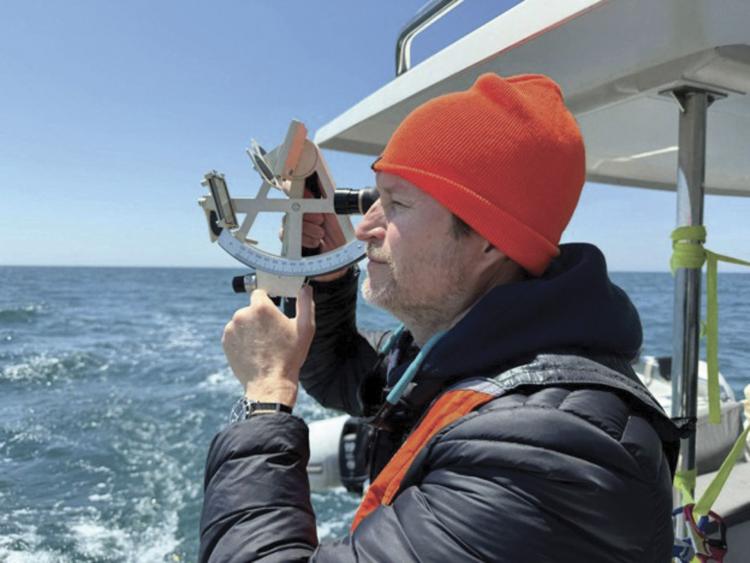
Every day provided hands-on opportunities to learn. We entered waypoints into chartplotters, checked weather forecasts, inspected engines each morning, reviewed safety equipment, adjusted sail trim, and peppered the experienced skippers with questions. At anchor, we practiced man-overboard recovery procedures, including hoisting a crew member back aboard using the boat’s equipment. We even squeezed in a rope-splicing class. And in a nod to the sailors who crossed oceans long before GPS satellites existed, we had the opportunity to learn how to use a sextant, gaining an appreciation for the skill and precision required to navigate by the sun and stars.
 An unexpected demonstration involving… vegetables?!
What made the experience especially valuable was that learning rarely followed a lesson plan.
One afternoon I asked a skipper what seemed like a straightforward question: “How do you turn a boat around for a man-overboard recovery?” Without saying a word, he tossed a zucchini over the side. “How long before it’s out of sight?” he asked. We were sailing at roughly eight knots. The answer turned out to be, “Not long at all.” The zucchini disappeared surprisingly quickly, driving home a lesson that no classroom explanation could have matched. Then he tossed an apple overboard and immediately hove-to. The boat slowed almost instantly, and the apple remained comfortably within rescue. His point was simple but unforgettable: in a real man-overboard situation, the first priority isn’t executing a perfect turn. It’s stopping the boat.
That brief demonstration lasted only a few minutes, but it taught me more than an hour-long lecture ever could. Those spontaneous teaching moments became some of the most valuable parts of the trip.
Under a sky packed with stars
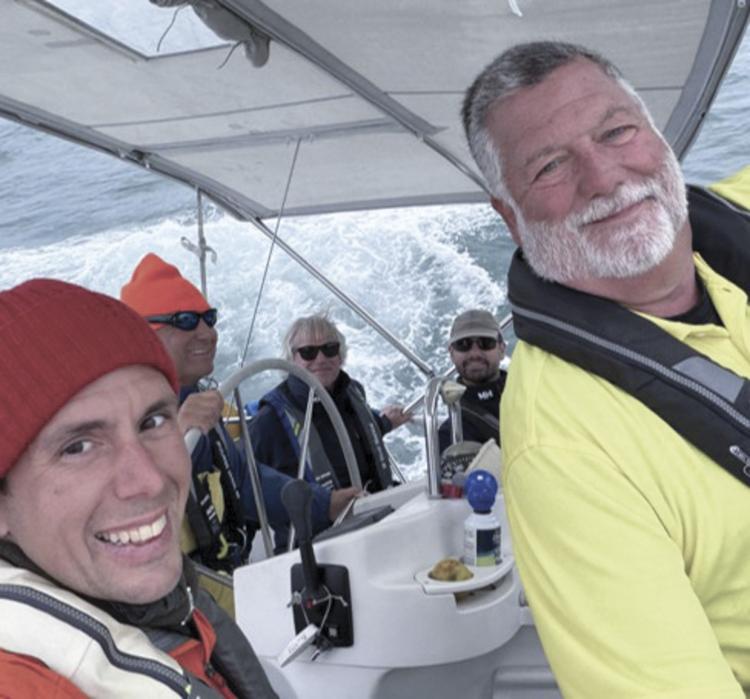
The daily schedule rotated everyone through four-hour watches, alternating between helm and lookout duties. For me, the highlight was the 25-hour offshore passage from Cape Charles, VA, to Cape May, NJ. I drew the midnight-to-4 a.m. watch and found myself under a sky packed with stars, a fingernail moon hanging off the port side, and a gentle following sea pushing us steadily north. Sailing wing-on-wing at more than five knots, the boat seemed perfectly trimmed while I simply enjoyed the privilege of steering through the darkness. It was one of those rare moments where everything comes together—the boat, the sea, the wind, and the silence. My time at the helm that night was nothing short of transcendent.
For the pure joy of it
Cape May was scheduled as a lay day, giving everyone an opportunity to explore one of the East Coast’s most charming seaside towns. While many took advantage of the break ashore, a handful of us looked at the steady 20-plus-knot breeze and came to a different conclusion. We decided to go sailing.
For most of the trip I had been assigned to the catamaran, which was wonderful, but I have a particular affection for monohulls. I blame my father for that. So, five of us untied the Beneteau and headed out with no destination in mind other than practicing tacks, gybes, heave-to maneuvers, and generally seeing what the boat could do. The wind delivered. The boat accelerated, heeled over, and came alive. We spent hours simply sailing for the pure joy of sailing. Someone should have called air traffic control because we were flying.
 It always comes back to the people
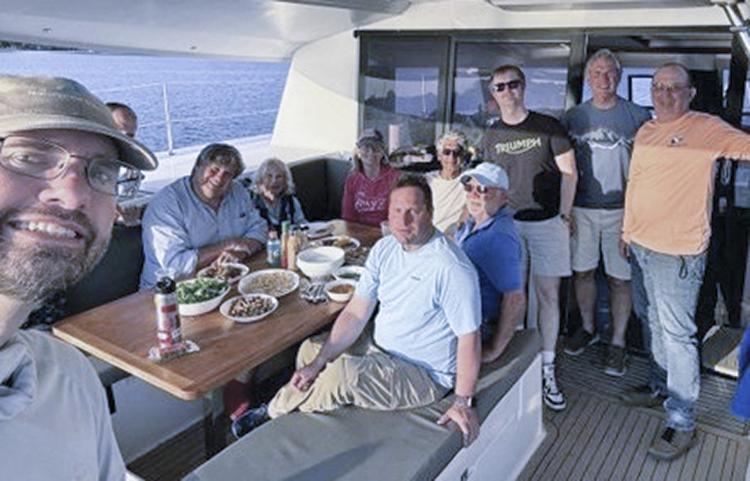
As much as the trip improved our navigation skills, sail handling, weather interpretation, and seamanship, the lasting memories came from the people. Shared watches become conversations. Conversations become friendships. Friendships become trust. By the end of the week, 11 sailors who began the trip with varying levels of experience had become a crew. That’s the hidden curriculum of a voyage like DelMarVa.
Yes, we learned navigation, route planning, engine checks, equipment inspections, anchoring techniques, offshore watch standing, and man-overboard recovery. But we also learned from spontaneous questions, from mistakes, from unexpected demonstrations involving vegetables, and from spending uninterrupted time with people who generously shared their knowledge and experience.
On a trip like this, it’s fair to ask whether the journey or the destination is more important.
The answer is both. But perhaps most important are the people with whom you share the experience. Patient skippers willing to teach, capable boats, incredible food, spectacular sailing, and evenings spent sharing stories over a bourbon after the anchor is set—that’s what makes sailing with Peninsula Sailors special and what made this DelMarVa unforgettable.
Learn more about Peninsula Sailors at sailbp.com. ~By Tom Chaleki
Find more sailing destination stories.


