When Coastal Engineering Meets Community Stewardship, Water Restoration Follows
A major transformation is taking place along the shores of the Hillsmere community in Annapolis, one that blends cutting-edge coastal engineering with grassroots community stewardship. The Hillsmere Shores Marina Shoreline Resilience project showcases how nonprofits such as the Arundel Rivers Federation can help communities adapt to increasing storm surges, protect their infrastructure, and revitalize long-lost shoreline habitat. What began as a necessary response to worsening storms has become an excellent example of forward-thinking restoration along the Chesapeake.
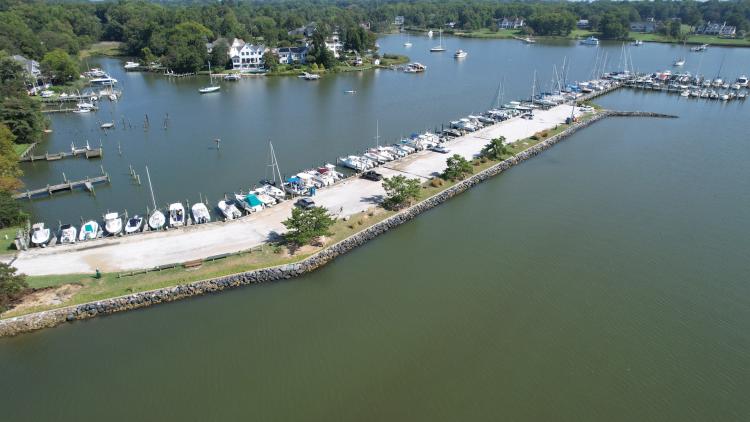
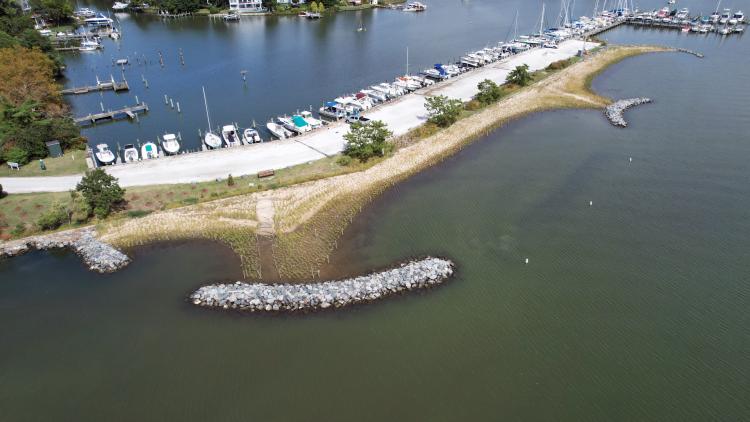
The project at Hillsmere Shores Marina has created more than 18,000 square feet of marsh complex, transforming the sand spit marina shoreline into a resilient, living system. At its core, it is a carefully engineered living shoreline that blends structural resilience with enhanced habitat. The shoreline’s protective system starts offshore with headland breakwaters: rock structures strategically placed to slow and redirect wave energy before it reaches the marina. At the shoreline, sand and cobblestone have been meticulously layered to support the newly planted marsh grasses, working to stabilize the shoreline, trap sediment, and filter stormwater before it reaches the river.
Below the waterline and just off the shore lie 258 new oyster reef balls, with dozens set with spat (also known as baby oysters) by the Chesapeake Bay Foundation. These oyster structures will promote oyster growth, improve water quality in Duvall Creek and the nearby South River through filtration, and provide vital habitat for fish, crabs, and other Chesapeake Bay critters. The oyster reef balls also serve as an additional speed bump to break up wave energy before it reaches the shore. With over 100 miles of fetch (or distance the wind may travel unimpeded over water) angled directly at the marina, this energy dissipation is critical.
The combination of these features makes this project an exceptional demonstration of how multiple restoration techniques can function together to protect infrastructure while enhancing habitat.
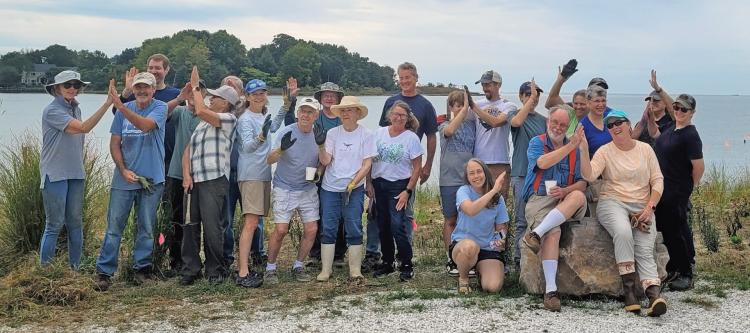
While large-scale construction at Hillsmere Marina wrapped up in early 2025, restoration didn’t end there. Throughout the year, volunteers, students, and community members helped complete extensive marsh plantings: hands-on work that connected the community to the project they helped bring to life.
The scale and success of the project was made possible through a remarkable coalition of partners. The project was managed by Arundel Rivers Federation, the nonprofit watershed organization for the South, West, and Rhode Rivers. Funding came from the Maryland Department of Natural Resources, the U.S. Environmental Protection Agency, Anne Arundel County’s Bureau of Watershed Protection and Restoration, the Chesapeake Bay Trust, the Hillsmere Community, and a Maryland State Bond secured by Delegate Dana Jones. Oysters were provided by the Chesapeake Bay Foundation. And the project was designed and constructed by regional engineering and construction firms, Environmental Systems Analysis and Resource Restoration Group.
Possibly the most integral partnership in this project has been the one built with the Hillsmere community. For over a decade, Arundel Rivers has been working with community members through programs to install rain gardens, monitor bacteria levels, and restore oyster populations. Community leadership was essential to expanding that partnership to the large-scale restoration of the marina’s shoreline. Hillsmere neighbors worked hand-in-hand with Arundel Rivers to engage the community, secure grant funding, and ensure the shared investment will protect the marina infrastructure for years to come.
Arundel Rivers has built trusted relationships with not only community members but also with the Key School, a private pre-K to 12 campus in the Hillsmere neighborhood. Thanks to community support, 60 Key School fourth graders now tend to oyster gardens at the marina each year as a part of their scientific exploration into the Chesapeake. In-class lessons with Arundel Rivers and marina-side spat counts create a strong foundation of knowledge for every year’s cohort, and these youthhood experiences on the river forge a lifelong love for our natural resources in these students. This resilience project will protect that experiential learning for decades to come by ensuring the infrastructure for it is stable and secure.
In an era of increasing coastal vulnerability, the Hillsmere Marina Shoreline Resilience Project offers a compelling blueprint for Bay communities seeking sustainable protection. The approach, which mixes engineered defenses, living shoreline elements, and habitat building features, shows how restoration can be multifunctional, benefiting communities, wildlife, and water quality simultaneously. Most importantly, this project demonstrates the power of collaboration between nonprofits, communities, government agencies, and all who love the water. Visitors to the restored shoreline, be it fourth graders, migratory birds, or neighbors walking their dogs, will now always have a chance to glimpse the future blueprint of river restoration built by so many hands and built for all to enjoy. ~By Charlotte Graves, Arundel Rivers Federation
For more information on this and other projects, visit arundelrivers.org or reach out to Arundel Rivers Federation at [email protected].


