The Search Is on for Horseshoe Crabs in the Chesapeake
Sailor alert! Can you help us? A special opportunity lies just ahead, and an enterprising scientist needs your sharp eyes. A small group of students and volunteers is on a mission this year to track the mating habitat of a curious, ancient Chesapeake creature—one that dots, and sometimes overwhelms, DelMarVa’s Atlantic shoreline.
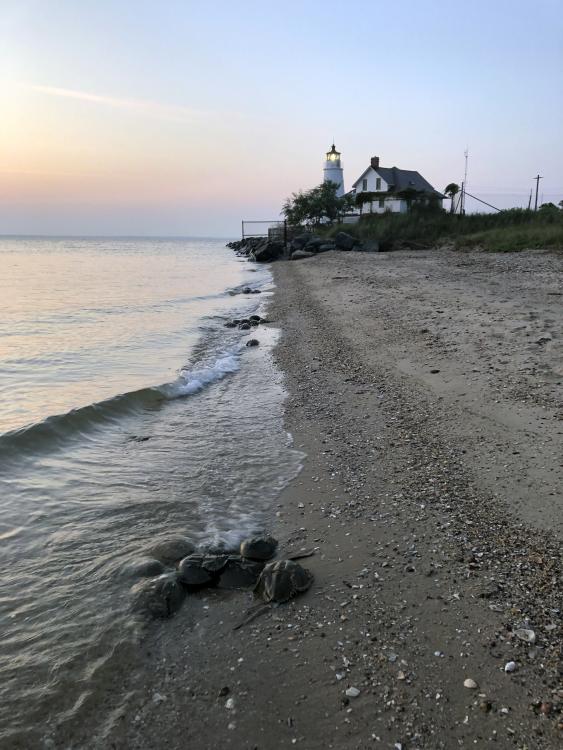
We’re talking about horseshoe crabs: where they come from, what purpose they serve, how they’re doing, and where they mate and lay their eggs.
Your help is needed not on the Atlantic coast but right here in the Chesapeake Bay, where sailors, powerboaters, and nature-attuned landlubbers can help track where these ancient survivors gather.
A Bit of History: Horseshoe crabs have roamed the oceans and coastal bays for more than 400 million years. They predate the dinosaurs—talk about resilience! They’re also a keystone species, providing a crucial link in the food chain. When they lay millions of tiny green eggs along sandy beaches, they fuel migrating shorebirds on their long journeys north.
Some fun facts:
Horseshoe crabs aren’t crabs at all; they’re more closely related to spiders.
They have 10 walking legs used to push along the seabed.
They spend most of the year “walking” the ocean floor, feeding on worms, clams, and other small organisms.
They have 10 “eyes,” or more accurately, multiple light-sensitive organs adapted for seeing in low-light conditions.
They’re only found on the east coasts of continents (sorry California).
They don’t sting; their tail (telson) is used for navigation.
In the modern era, horseshoe crabs’ blue blood plays a critical role in ensuring the safety of injectable medicines. They are also harvested for bait. Under these market pressures, populations in some regions have declined, raising concerns about impacts on migratory birds and overall ecosystem health. Since the Chesapeake Bay is a major flyway for migratory birds, this could portend trouble ahead.
The Big Question: How many horseshoe crabs are in the Chesapeake Bay? Is the population stable, shrinking, or growing. If it’s declining, the next question is why: climate change, harvest pressure, water quality, or something else? There’s just one problem.
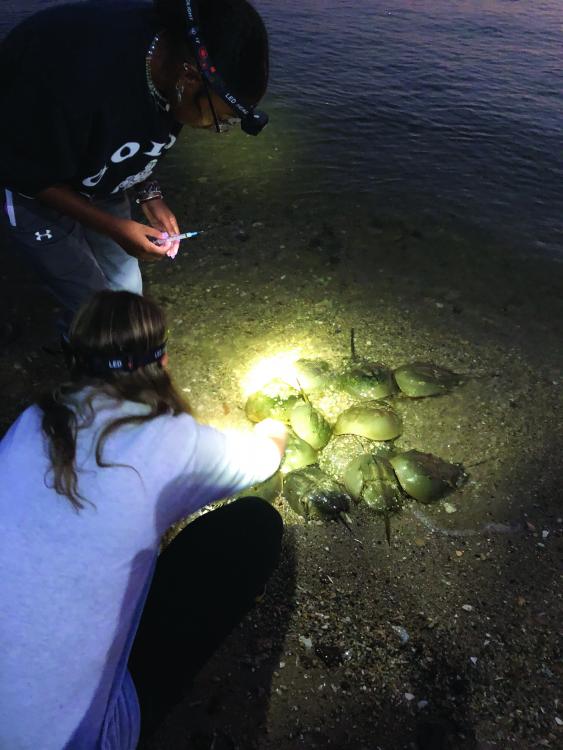
How Many Do We Have? “Nobody knows for sure,” says Professor Tammy Domanski (PhD) with the Biology Department and Environmental Center at Anne Arundel Community College (AACC). “There’s never been a proper population survey in the Bay.”
Some localized habitat work has been done around Cove Point and Flag Pond to assess environmental impacts. But Bay-wide? The data simply doesn’t exist.
To create that dataset, Dr. Domanski and her students began tracking these ancient creatures. The best time to count them is during mating season (late April through early July). Domanski’s team began surveying them a few years ago at Sandy Point State Park and later expanded to 10 areas in the mid-Bay.
The Tricky Part: Here’s why most of us never see them: horseshoe crabs come ashore only to mate, only during high tides around full and new moons. That means Domanski’s team is counting at around 4 a.m., perfect for those who enjoy their coffee, as a certain Eastport singer might say, at “o-dark-something in the morning.”
Where Is This Habitat?: Favored habitat for horseshoe crab mating is on sandy beaches with gently sloping underwater topography. That’s where these armored romantics meet up. Horseshoe crabs are known to frequent brackish waters where the salinity is at least six parts per thousand (ppt). This means their habitat may extend well into Bay tributaries.
This reporter spotted two large females at Jonas and Anne Catharine Green Park on the Severn last June. Do they lay their eggs in these areas? That wasn’t clear… it was late, 6:30 a.m., so the action was over.
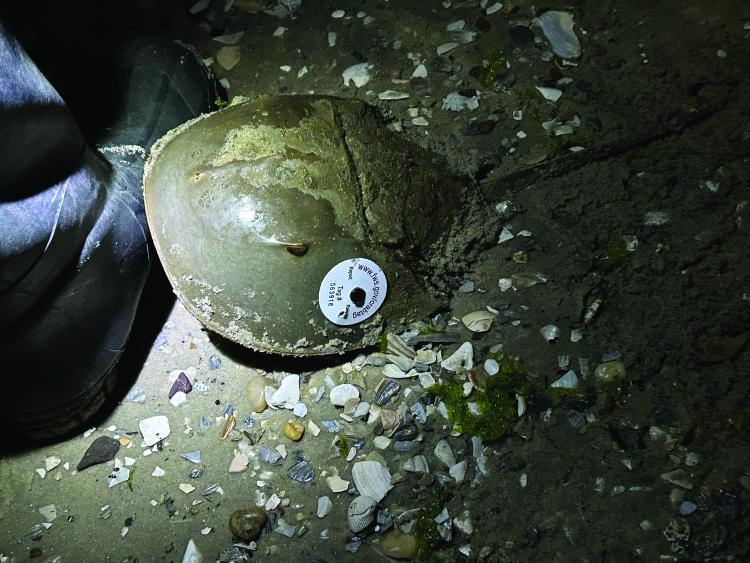
What You’ll See: At the right time and place, the scene is remarkable. Females come ashore at high tide so that they don’t have to “walk” too far to lay their tiny green eggs in the sand. They’re followed by clusters of males, often forming snake-like chains. As the female lays her eggs, the males fertilize them as they pass over.
Where Cruisers Come In: Domanski’s team surveys public beaches such as Sandy Point, but horseshoe crabs also visit tributaries. That’s where you can help. If you’re anchored out and heading ashore at dawn (maybe giving the dog a break), you may witness this spawning activity firsthand. With a simple checklist, you can contribute valuable data.
If you’re on the beach during early morning high tides around a full or new moon, look for clusters of crabs. Take a photo. Note the location and time, and report how many you observed to help guide future surveys. If you miss the action, walk the high-tide line and look for clusters of small green eggs in the sand. Once you’re back aboard, keep an eye out for migratory birds enjoying a well-earned breakfast.
You can report sightings through the Maryland DNR Horseshoe Crab Tracker; click on the “map” link in the first paragraph. To volunteer with the AACC surveys, contact Professor Domanski at: [email protected].
About the Author: Thomas Guay is an observational scientist, river rat, and musician with the Eastport Oyster Boys. He founded Eco-Ed Endeavors to “turn students into scientists.” He is also the author of the historical novel Chesapeake Bound (McBooks Press): thomasguay.com.


