We were bluewater sailing, and the moment of truth had come and gone; the decision was to press on.
Often, the worst part of making bluewater sailing decisions is the contemplation. Once you’ve made a choice, all that is left to do is to carry on—and carrying on seems to make clear what you need to do. So, you reduce sail, tweak your heading, and keep a nose to the wind for change. No longer putting energy into making a decision is liberating.
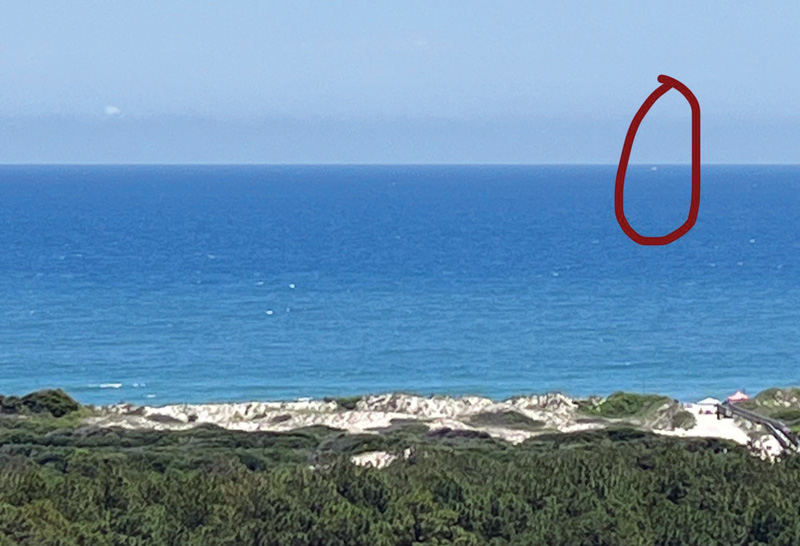
Bluewater decision-making
Bailing out into Beaufort, NC, had been a thought, but the weather seemed calm enough and the sea state was delightful. So, we pressed on aboard the Privilge catamaran Dragonfly, rounding Cape Hatteras and its infamous Diamond Shoals northbound to Deltaville, VA, from the Bahamas. The weather reports had been somewhat iffy with predictions of atmospheric instability ahead of us. The weather expert Chris Parker recommended we bail. But we felt good about our situation and kept on.
There were just two of us, the owner and me, and we decided to honor Red #2, the Outer Diamond Shoals buoy, keeping the worst of its shallows safely abeam. We motorsailed north in the morning light in good spirits and wondered what excitement might lie ahead.
It was late morning off the southern Outer Banks when things changed. In the cockpit, the owner and I both felt it: a dip in the temperature and a crisp, electric pulse in the air.
“Douse the main?” I suggested.
Mike, the owner, nodded. In short order it was down and in its stack pack as Dragonfly crept steadily northward. The skies began to darken.
The squall line wasn’t hard to see, and as is so often the case, there was nothing else to do and nowhere else to go when it arrived. Mike and I shared the cockpit, watching with a sense of awe. As the rain intensified, we stowed, tucked, and tied the myriad of miscellany that accumulates on every passage—loose lines, random electronics, and abandoned articles of clothing went away, out of the rain and into the main salon. As we worked, I kept one eye on the anemometer. All around us sheets of rain blew sideways across the waters of the Atlantic.
“That’s 40,” I yelled from the helm. “Forty-five!”
Dragonfly remained unfazed as her twin hulls kept us comfortably level. I grabbed my phone and got some video, something I would never have been able to do on my own boat while excitedly hanging on for dear life. As I panned the camera, Mike slowly came into frame. I asked how he was doing. Mike grinned and offered me two thumbs up.
“This is fun!” he replied. I wasn’t sure he meant it.
Eventually the squall abated, and slowly the sun reclaimed its place in the May sky. The cockpit slowly started to dry, and Dragonfly kept on. A glance at the anemometer showed that the winds had peaked at 55 knots. I made a mental note, as it was a fine number to weave into a story later at a bar.
That squall—while intense—was the only adverse weather we had that day. Mike and I soon got back into passage mode. The low dunes on the shores of Avon and Frisco made a fine backdrop for stories of life on the Outer Banks, a place I had called home for a decade in the early 2000s.
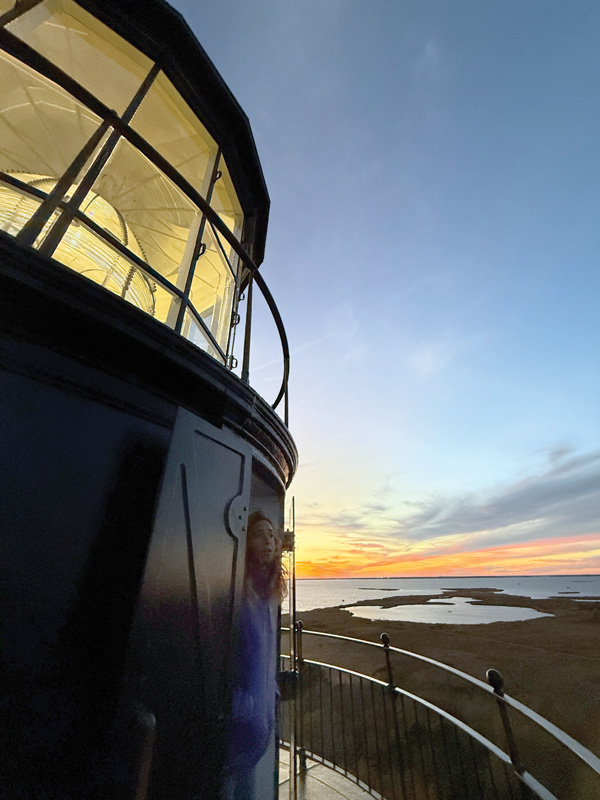
A wave from the lighthouse keeper
We sailed past the Bodie Island Lighthouse, so named because of the bodies that used to wash ashore there, and past Nags Head, Kitty Hawk, and the Duck Research Pier. Soon I started scanning the horizon for the Currituck Beach Lighthouse, in whose shadow I used to live.
I told Mike what I knew about the lighthouse and stories of its first-order Fresnel lens, of lives lost when it first began operation, and of ghost hunters investigating the original keeper’s house in the quiet cold of the off-season. Amidst the warm glow of stories of days gone by, I picked up my phone and texted my friend Meghan, the lighthouse keeper.
“Look east and wave,” I said. “I’ll wave back.”
“Wait. Where are you??” she responded.
“Four miles offshore,” I explained, “just east of you and the lighthouse.”
The lighthouse was still a tiny speck on my horizon, but the human connection with its keeper was real, and connections matter so much in life. Meghan climbed the 220 steps to the lighthouse’s observation deck to try to spot us bobbing about out in the Atlantic. She was soon asking where to look and how to recognize the boat I was on. My phone dinged.
“I see you!”
Mike and I beamed with pride aboard Dragonfly, having been successfully spotted among many square miles of ocean. As we waved in Meghan’s direction, my phone dinged again, this time with a video. In it were four complete strangers to me, four tourists who had found themselves caught in someone else’s story line, all waving together with Meghan from the observation deck of the lighthouse, all saying “Hi, John!” Mike captured me returning the wave, and we sent the file to Meghan as we slowly returned to the task at hand: sailing Dragonfly.
It’s a thing, now, the waving to the lighthouse from the sea. It works when it works. Sometimes I round the banks in the dark of night. One time an electrical storm thwarted our plans. But there’s still a connection there between two old neighbors, one that welcomes new members into its club when opportunity presents itself.
Maybe if you’re lucky your $13 climb to the top of the Currituck Beach Lighthouse will end with you waving hello to a passing sailor, too. You just never know.
by John Herling
About the Author: John Herlig is a delivery captain on the US East Coast and the Caribbean, a teacher at Cruisers University, and a boat driver for the Annapolis Boat Shows. Find him at [email protected].


