Anchoring that is not too risky, not too close... just right.
Our arrival in Portsmouth, ME, was gray and drizzly in August. Nevertheless, I was on cloud nine. When we left our home on Lake Ontario aboard our 1972 Bowman 46 Mug Up, snaking our way down the Erie Canal to the Hudson River and Manhattan, Maine felt like a faraway star. It felt like a magical place we loved but were unsure if we could trek more than 200 miles that far north our first summer aboard full-time, knowing that the goal was to be in the Chesapeake for the Annapolis Sailboat Show in early October, before heading south to the Bahamas and beyond. (How naïve we were! Two hundred miles felt like light years away.)
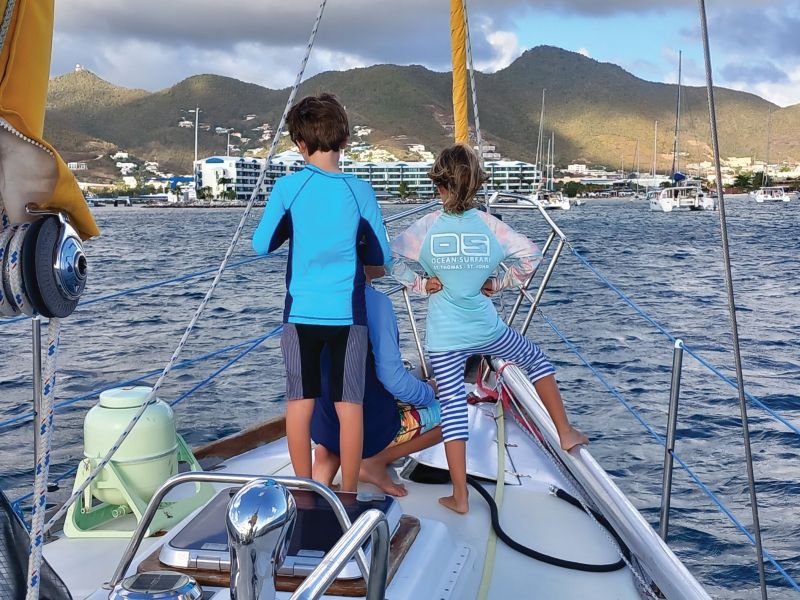
Yet, as I stood on the bow to drop the anchor, I felt a great sense of accomplishment. We’d made it to our summer wonderland!
The weather was forecasted to deteriorate later in the afternoon, so this was to be our final resting place for the evening. Our buddy boat anchored beside us. All was well, or would be, after more effort. This is when I learned something new about myself: I’m Goldilocks when I anchor. I’m looking for the just right spot.
The wind swirled a bit. Even with the bridle on, I could hear the chain grinding over rocks below us. Yes, the chart indicated rocks. Sigh. Foul-weather coat back on, I went back to the bow, and we re-anchored. This time, as we settled, we didn’t like our position relative to the boats on nearby mooring buoys.
Third time’s a charm.
By the third time, our friend’s voice crackled on the VHF, chuckling at us, questioning why the heck we were anchoring yet again. After all, they anchored just fine the first time and were ready to relax, beers in hand. We, however, seemed to be working extra hard. Still new to cruising, two months into anchoring every night, sleeping well required knowing our anchor was well set. Even with an anchor alarm, the knowledge that the anchor was secure with a good swing circle was important to our mental well-being. Not too rocky, not too close… just right.
We loved our three weeks in Maine before heading south to the Chesapeake; we barely scratched the surface of what Maine has to offer. We still say, “One day we’ll go back.” But let me say, the satisfaction of dropping our hook in Chesapeake mud and knowing it wasn’t going to budge had me sleeping like a baby all through September and October!
Part of me admires our friends who drop the hook, set the hook, and walk away. Like, wow! They are so confident! Yes, I absolutely love and trust my anchor. But once we set the hook, we take a deep breath and watch our surroundings, at least for a few minutes. Is there a current that is countering the wind? Are we in sand or some other combination of seabed that might make our holding poor?
After five years of achoring...
Five years later, it’s easy to say we’ve anchored a lot, from the East Coast to the Caribbean and through a large swath of the Mediterranean. Yet, as we roamed through the semi-crowded anchorage in Playa Blanca, Lanzarote, in the Canary Islands, I worried that we looked like beginners. First try—too close to the underground pipe. Second try—not a good set with the lava rock. Third try—neighbors yelled we were too close! We didn’t think so, but as we didn’t want to disrupt their sleep, we picked up the hook again. Rain was headed across the water in thick sheets, so we hid for our fourth time outside of the marina’s breakwall where the chart indicated sand. We couldn’t stay there, though, as the ferry wake rolled past us in an untenable way. Once the rain passed, we tried once again. This time, the fifth time was a charm… sort of.
Jeremy dove down to check the anchor. Now we were at the back of the pack, meaning we were least protected and had a long dinghy ride to shore, but with the sun close to setting, it would have to be okay for the night. He reported that the seabed was nothing but lava rock; no sand in sight. So, he wedged our Rocna anchor in a hole, and we slept well.
Throughout the Caribbean and Med, we’ve watched all sorts of anchoring styles. Anchoring while still moving forward at a good pace. Dropping barely enough chain for the anchor to kiss the seabed. Not backing down on the anchor to ensure it’s set well. And everyone’s favorite, anchoring way too close and staring at us like we’re the problem.
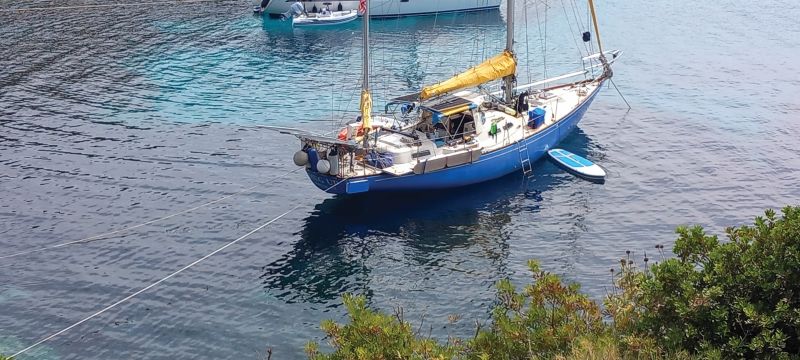
Our two months in Ionian Greece, for us, was hands down the most stressful, all hands on deck style of anchoring we did repeatedly. Stern-tying required dropping our anchor in the deep water of a small bay. Backing our boat and home toward shore (and not just a sandy beach, but toward jagged limestone rocks) was both disconcerting and exhilarating.
My oldest kid, 15, would jump on a paddleboard with 300 feet of anchor rode and paddle to the rocks, tying us to those rocks. I would pull in the excess rode, tying us taut, while Jeremy kept us in reverse idle. Our 12-year-old stayed on the bow, in case we needed more chain let out or pulled in, and our youngest, nine, maintained her role as midshipman, making sure everyone heard the instructions. We stern-tied a total of a dozen times during our time in the Ionian islands, and while we loved our time there, we were so happy to stow our extra anchor rode for the last time and head west, knowing we would be anchoring in our preferred style from then on, the kind that feels just right.
I’m sure how people anchor is slightly individualized for the boat and people aboard. When we started cruising, I’d only anchored a dozen or so times. It was important to me that I be able to function in both roles: handling the helm or the anchor on the bow. That practice was empowering, and I’m confident in both roles, even if it does take me several times to feel like I’ve reached the Goldilocks peak of anchoring. After all, I want Mug Up to sit not too close, not too far away, but just right, with her anchor snug in sand.
By Jillian Greenwalt
About the author: Jillian Greenawalt’s husband Jeremy learned to sail while in college on the Chesapeake Bay and taught her to sail. In 2021, as a family of five, they cast off the lines to cruise on their 1972 Bowman 46 Mug Up down the East Coast and Chesapeake, to the Caribbean, the Mediterranean Sea, and now back to this side of the pond.


