A Conversation With Adventurer-Sailor Matt Rutherford (Underway) About His Latest Feat
Chesapeake sailors know Matt Rutherford for his record-breaking solo sail around the Americas in 2011-12, his Ocean Research Project (ORP), and more exciting bluewater voyages to collect environmental data at sea. Now, the adventurer has embarked on a new journey around the Arctic, solo, aboard his Valiant 42 Chimera. We spoke to Rutherford last week by phone (Starlink) as he sailed about 100 miles offshore of the southern part of Greenland.
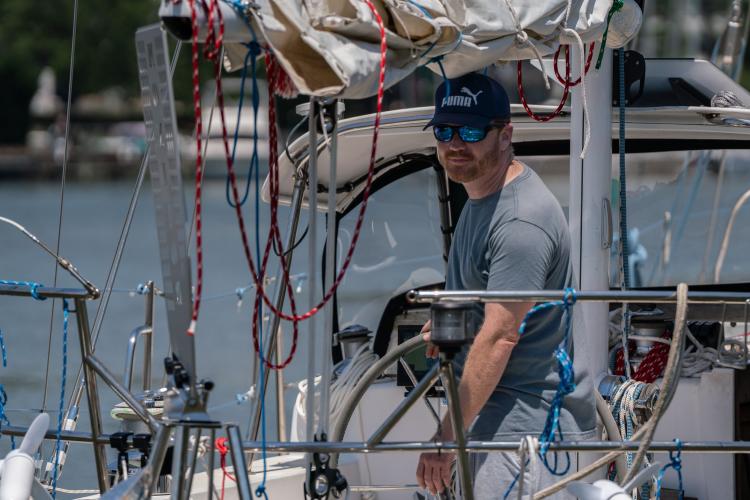
How’s your day going? What are the sailing conditions like?
I’m making good time today. It’s blowing 16; yesterday it was blowing 30-something. I’ve had to sleep with my boots under the dodger because of the icebergs. Hopefully I will get back to sleeping inside rather than outside.
The bottom of Greenland windiest place in the world, more than Cape Horn. I’m trying to get around it now. Blowing in 30s is normal for bottom of Greenland. It’s quiet right now, with 16 knots, blowing the right direction today. I’m extremely lucky with wind direction so far. Northerly winds bring colder air but not the fog the southerly brings. Dodging icebergs in the fog is really hard. Luckily this wind has been northerly… tomorrow will pick back up from the west which will help. I will stay about 100 miles offshore. A massive current comes around bottom of Greenland and brings ice with it; current pushes you in the wrong direction (like at Hatteras). It’s a magnitude winder than Hatteras, so that’s why I will stay 100 miles offshore to avoid the ice and current.
What do the next 10 days look like—ideally?
The next two goals are to get around Greenland and then get across Iceland. There are a lot of strong headwinds there. I expect in the next 10 days, I should be getting to Iceland. Winds will pick back up out of the west will get me around southern Greenland. I expect to start living inside my boat again. I have a list of projects to do on the boat. There are no storms on the forecast; that can change of course.
July has the lowest frequency of storms in the North Atlantic. It’s not necessarily the best time to do Transatlantics because of tropical storms; but they don’t come this far north in July. This is the ideal month for me. It’s kind of like doing a super duper far north transatlantic! You might be becalmed, which is the flip side of it. I’m trying not to use any fuel til I get to Russia, hopefully in Aug. 1, especially if I keep getting lucky with winds. In Iceland, winds often coming from the wrong direction & blowing like an SOB. It’s anyone’s guess what will happen between Iceland and above Scandinavia.
Is there anything you’re afraid of or hyper alert for?
I guess the first thing is not falling off the boat. Ice is a big thing. The hardest part is sleep deprivation. If you hit an iceberg, you could be dead. Over the past five days, I’ve slept five hours max.
What are you wearing?
Long johns, sweatpants, foul weather bibs, hoodie, a vest heated with batteries (it’s nice! Didn’t have that for tirp afound Americas.), two pairs of socks, indoor & outdoor gloves. I’m essentially living in the fridge. Average temperature is like your fridge.
What are the safety features on the boat?
I have what you’d expect in a liferaft, EPIRB, windvane. I also have a massive mount of extra diesel fuel so that I can get through the Northwest Passage. That’s a huge safety situation, to keep moving in light winds. Eight to 10 knots above Russia is typical, so being able to keep moving is important. The water is 36 degrees; so why bother with PLB. You cannot fall in or you’re dead.
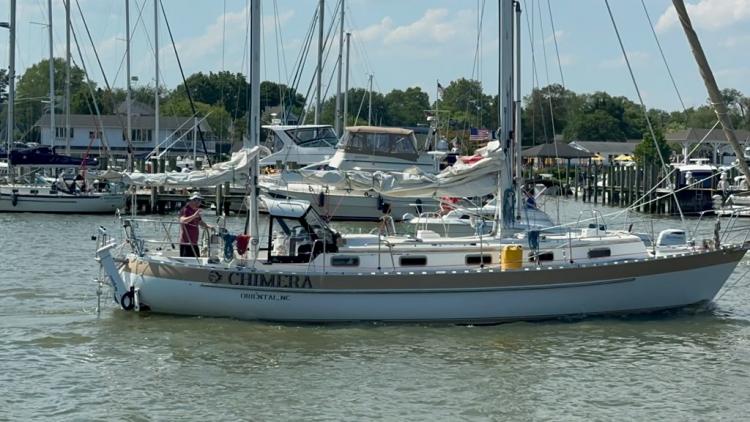
When it comes to communications, is it true you’ll have a blackout period over Russia?
I’ll have to turn off Starlink. When I went around the Americas 15 yrs ago, I had an Iridium Sat phone, no data download, but over time they created the Iridiuum Go. The Iridium system has a problem in that they have not changed the satellites. You can get to the internet, but it’s very slow, but you can download grib files for weather. Starlink came along and it changed everything. The speed of Starlink is sometimes better than in my office (upstairs from SpinSheet in Eastport). It’s a massive game changer, but the Russians have banned it. The moment I go to 130 longitude, it should go black.
I have the Iridium Executive now. It’s five times as big as the Iridium Go and much faster. The calls still aren’t great; voices sound different. I will be able to get weather forecasts. Nicole (Trenholm at ORP) and another friend will send me information and screen shots about ice so that I can navigate the heavy ice floes. In that area, I will be radio silent on standard comms but won’t be totally out. Just can’t do interviews or be on internet. All I need is weather and ice info. What to worry about above Russia is pack ice, the kind of stuff that sank Shackelton. Pack ice will crush you’re ass, crush your boat and liferaft.
Why are you doing this?
Why did Sir Edmond Hilary want to climb Everest? ... Exploration is inside all of us. Humans have been exploring for thousands of years. Sailboats are expensive, and you spend a lot of time and money fixing them to go in the ocean and get your ass kicked. The ocean will ultimately make your life much harder. It’s a sense of exploration and wonder and adventure that takes you there. I’m not unique in that I have that. I have a bigger ghost than most have. There’s a scale for every one; I’m on the more extreme end of the scale.
You’re raising money for ORP, too, right?
Our research vessel needs an new engine. We’d like to buy more science equipment for the lab, so yes raising funds for the ORP. This boat was donated; a lot of the boat is new; the engine is a rebuild, so needed work. I’m always messing with it; always giving me a hard time, which is a safety factor up here. Also funding for ocean and polar research has been cut because of this current administration, so we need help.
How can SpinSheet readers follow your experience?
Go to oceanresearchproject.org for tracker device (it’s a little wonky on a phone; better on computer). It shows the map and route and the history of various research project that we’ve done. Follow our YouTube page for a weekly video. You can see weather and all about ORP, and our Singlehaded podcast. You can donate, too.


