Rutherford Embarks Upon Epic Solo Sailing Circumnavigation
In the Old Harbor at Block Island, RI, there used to lie a wooden fishing boat with a provocative name: G. Willie Makit. I thought of that boat the last time Matt Rutherford left Annapolis on a death-defying sailing voyage at sea, and it’s front of mind again.
Fifteen years ago Rutherford made history by circumnavigating North and South America, 27,000 miles alone in a 40-year-old, 27-foot sloop, nonstop. When he left, few thought he’d make it back to City Dock. But he did, to a hero’s welcome, 309 days later.
Now, the Chesapeake Bay’s premier nautical adventurer is at it again. If all goes to plan, he’ll leave Back Creek in Annapolis in May to sail around the world, solo and nonstop, via the Arctic. Like his last epic trip, it’s never been done before, never tried, and it’s a challenge fraught with peril.
“I started thinking about this trip as soon as I finished the last one,” said Rutherford, 44. He was always too busy to carve out the time. In the last decade and a half, he has brought to life his nonprofit Ocean Research Project (ORP), built out a 70-foot, steel research vessel, led six summer-long trips to northern Greenland for scientific work, and crossed both the Atlantic and Pacific Oceans under sail, monitoring plastic pollution.
All that research left his science partner, Nicole Trenholm, with so much data that she required a year ashore to process it, just the window Rutherford needed.
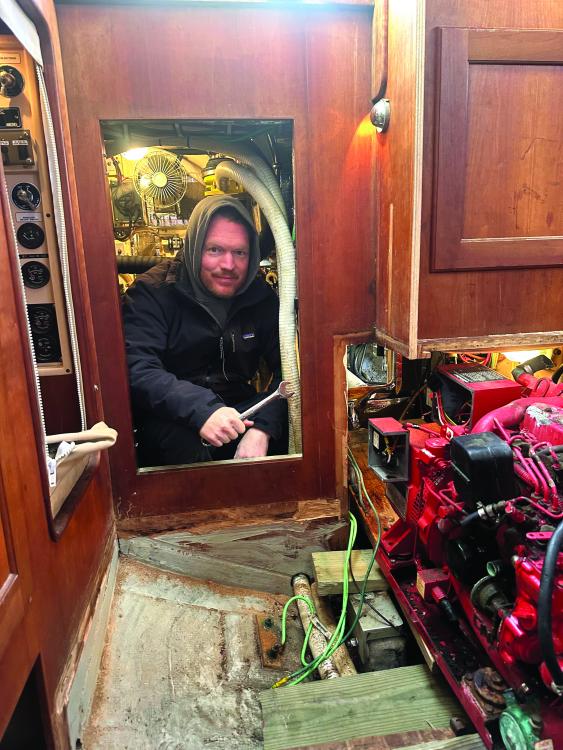
This winter he and a few occasional helpers have been hard at work at Bert Jabin Yacht Yard, outfitting a 42-foot Valiant ketch for the Arctic. The boat is on loan from a listener to Rutherford’s popular podcast, Singlehanded Sailing. Unlike little St. Brendan, in which he survived the Northwest Passage and Cape Horn in 2011, the 30-year-old Valiant is a tough seagoing trooper, well-suited for the job.
But still, it needed almost everything. By departure day, Rutherford will have stripped, painted, and refurbished the masts and booms, replaced all standing and running rigging, installed a new engine and battery bank, replaced sails, and renewed the electronics, winches, lines, electrical, and plumbing systems. Most of the work he’s done himself, mostly outdoors in the cold and snow.
“It’s okay. It gets you ready for the Arctic,” he says with a shrug.
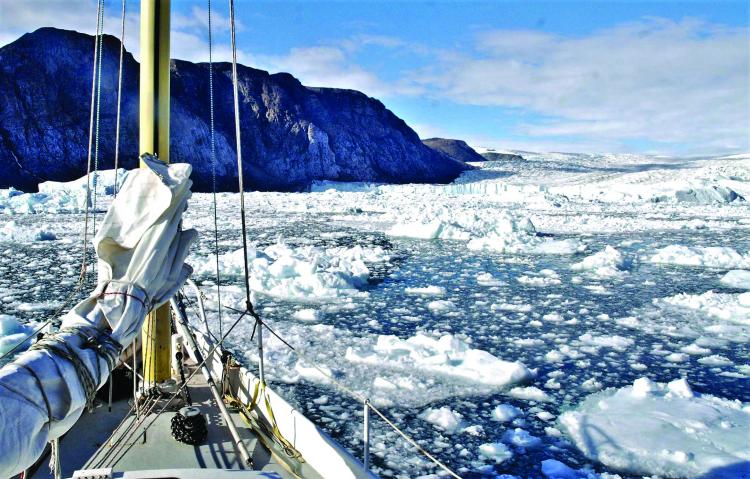
What he will attempt is unprecedented. It’s 9000 miles, alone and nonstop, from Greenland to Greenland over the tops of Scandinavia, Russia, Alaska, and North America, going west-to-east with the North Pole off the port side. Timing will be crucial. Pack ice in these regions generally doesn’t retreat enough to open a path until June, and it all closes back up in October.
The dangers are fourfold, in his estimation. The first is ice, in two treacherous forms. Pack ice is the frozen sea water that extends south from the North Pole. Skirting its edges and forging through errant patches are tricky, because the ice comes and goes with wind and tide and can entrap the boat and crush it. Meanwhile, icebergs, the massive, frozen freshwater blocks that break off glaciers, float unmarked in open waters in the dark of night or murk of fog. Hitting one invites disaster.
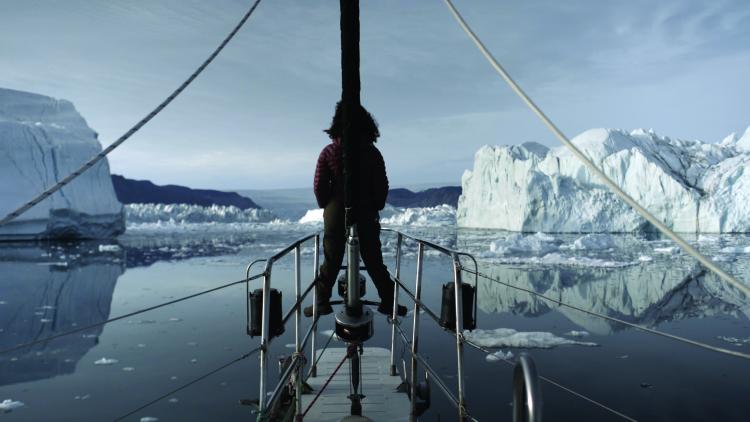
Rocks and pinnacles are second on the danger list. Even the best digital charts are imperfect in the Arctic, he says, and unmarked obstacles can sink and swallow a fiberglass boat in no time. Third are storms, inevitable on the open sea. Rutherford spent 10 days hanging off a parachute sea anchor on his last trip, waiting for howling gales to peter out in the Arctic Ocean. And, of course, there’s always the threat of a combination of storms, rocks, and ice coming at the same time.
Finally, there’s politics. The route extends over Russia for thousands of miles. The Putin administration claims sovereignty over all waters north of its border and requires a permit for any boat to go there. Rutherford has applied for permission and expects to get it, but even with papers in hand, there’s no telling what the Russians might do to a hapless American in their waters.
When he put to sea on his last bold mission, Rutherford used the voyage to raise funds for the Annapolis-based nonprofit Chesapeake Region Accessible Boating (CRAB), which takes disabled people sailing from its base on Back Creek. He generated $120,000 in donations.
This time he has his own nonprofit, the ORP, and hopes the trip will help focus attention on it. He’ll be equipped with a year’s worth of freeze-dried food, a mechanical watermaker, and the latest Starlink communications gear, which he says is as fast and reliable as a home computer system. He can send video, photos, and text back to the ORP website from anywhere, although he expects the stretch over Russia to be blocked.
The plan is to sail north in May to the island port of Aasiaat, off Greenland’s west coast and there await word that sea ice is clearing in the Northeast Passage over Russia. He will sail around the bottom of Greenland, past the coasts of Iceland, Norway, Sweden, and Finland, over Russia to the East Siberian Sea, and across the Arctic Ocean to approach the Northwest Passage over the Americas.
He needs to be through the Northwest Passage and into Canada’s Baffin Bay by October to avoid the return of sea ice. Then, it’s just a matter of getting back to Aasiaat to complete the historic circumnavigation.
This leaves one outstanding question left to answer: Gee, will he make it?
Learn more at oceanresearchproject.org.


