Prepping Your Sailboat for Spring Sailing Season
It’s time to get your baby out of mothballs. How you tackle annual spring commissioning tasks is up to you, but it’s an unavoidable part of sailboat ownership. You must budget for it, both in time and money. If you don’t already have a checklist, here’s a primer on where to focus your attention.
 Washing, Waxing, and Detailing
Hopefully, you washed and waxed the hull before you stowed the boat for winter. It does make spring cleaning easier, but dirt still builds up even under a cover. Rinse the hull and all surfaces and tackle tougher stains with cleaners. Remarkably, toilet bowl cleaner can do wonders on decks. Just test a small area first. Wax the gelcoat to look its shiny best. For good results, buff the cabin top and hull with an abrasive polisher first and apply wax.
Waxing over chalky gelcoat won’t look great or last long.
Don’t forget to deep clean cockpit cushions and fabric structures such as dodgers and isinglass enclosures. Most fabrics have recommended cleaners, but mild soap and water are usually safe. Check the entire boat, inside and out, for mold and mildew, which is inevitable after the boat is laid up. Sprays are available, but at least wipe down the areas with a damp sponge to remove the worst of the stinky stuff. Polish the rust off the stainless (it’s stainless, not stain-free), and do the brightwork or varnish on wooden surfaces such as toe rails and companionway trim.
For DIY, remember that the cost of cleaning supplies and varnish will run at least $200. Professional cleaning services charge by size of the boat but can easily be $25 per foot and more for catamarans which have two hulls and more deck surface. Polishing and waxing are expensive due to the amount of labor needed, and they’re also estimated by length of the hull and the complexity of the superstructure.
Buff Your Bottom
Boat hulls kept in the water year-round attract growth both soft (grasses) and hard (creatures). Growth adds weight and friction which makes the boat slower and more fuel hungry, so don’t even think about racing until the bottom is cleaned which can run $2 per foot for a professional diver. Boats stored on the hard need to be inspected for bottom condition as well.
Spring is a great time to add a coat of anti-fouling paint. This is usually not a DIY project, especially on larger vessels. A boatyard will power wash the hull, repair any osmotic blistering, and charge by the linear foot and the type of bottom paint. While the boat is hauled out, inspect the shaft and shaft seal/packing gland, the prop, and the exhaust manifold, which are easier to access if the boat is on the hard.
 Engine(s), Systems, and Batteries
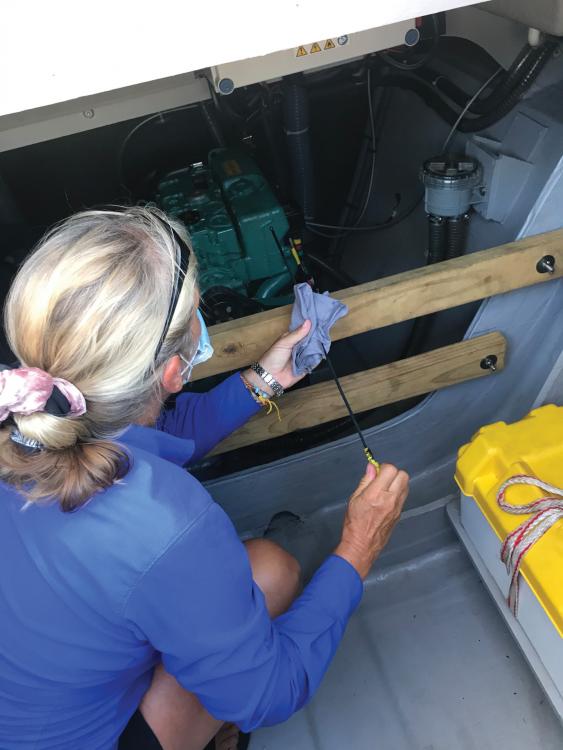
Engines save the day when the wind is nil, so inspect the inboard diesel. Change the oil and check the belts, pump impellers, and hose clamps. For small outboards on little sailboats, replace the sparkplug, change the oil, and grease the lower unit. You may need to flush the engine cooling system and check the transmission fluid. Don’t forget the generator, which is basically another engine.
Depending on the complexity of your boat, you may have just a few or quite a few systems to test and troubleshoot. Start with a bit of safety equipment such as the windlass. While you’re at it, lay eyes on your fire extinguisher and flare expiration dates. Test all pumps including your electric and manual bilge pumps. Look at the steering cables; they should be clean and move smoothly. Turn on electronics to burn off condensation, try all the lights and fans, and run the refrigerator and stove so that there aren’t any surprises on your first overnight.
Unless your batteries are sealed, as with AGM or lithium banks, top up fluid and measure cell health. If there’s a voltage drop under load, you may have a failing cell. Ensure that all batteries, regardless of type, are secured in their compartment and have a fire extinguisher nearby.
Sails and Rigging
Inspect all sails and wash or mend them. Dacron cruising sails can last years with normal use while hardworking laminated racing sails are more fragile and expensive to replace, so take a close look to see if the layers are showing breakdown or mold. Restitching Dacron is good insurance against a catastrophic tear during the season.
The running rigging (the lines that manage the sails) is subject to UV damage and stretching. You may need to whip the ends or over-end the sheets and halyards to move chafe points. While you’re at it, soak all lines in fresh water so that they’re salt-free, pliable, and ready for use.
Standing rigging, comprised of the stays and shrouds that support the mast, should be tuned and inspected. Most boat owners will use a professional rigger, but you can tune a rig yourself if you have the proper tools and skills. Check for any loose hardware, especially around turnbuckles and lifeline stanchions. They’re called lifelines for a reason.
Getting it Done
DIY commissioning is an option, but you’ll need the skills, patience, and time. Professional services may cost you three to 10 times more than doing it yourself, but for some tasks such as applying bottom paint or repairing sails, it’s best to leave it to the pros. Start early, and you’ll be summer-ready before the breezes warm and the anchorages fill up.
~By Zuzana Prochazka


