A Guest Crew Member on the Pride of Baltimore II Celebrates Sail250
I had the good fortune to sail from Baltimore to New York City aboard the Pride of Baltimore II as part of Sail 250, one of the flagship events in the celebration of the 250th anniversary of the United States. It was an experience I will never forget, not only because of the scale of the event, but because I was able to see it from the deck of a historic vessel and take part in the work of the voyage along the way.
We left the dock in Fells Point, Baltimore, at 1 p.m. on Tuesday, June 30. The Pride had just been part of the Sail 250 Baltimore celebration, together with many other American vessels and tall ships from around the world. Public deck tours had been offered in the days before departure, and many visitors came aboard to see the Pride for the first time.
A little background on the Pride of Baltimore: The first Sail Baltimore was held in 1976 during the nation's 200th anniversary celebration. It was such a success that Baltimore city and state leaders decided to build a vessel that could serve as a maritime ambassador. The original Pride of Baltimore was launched on February 27, 1977. She was built in the style of an early 19th-century Baltimore Clipper and, during her nine years of service, visited ports along the East Coast, throughout the Caribbean, on the West Coast, and across the Atlantic to Europe and beyond. Her mission was to represent the City of Baltimore and the State of Maryland.
That mission came to a tragic halt on May 14, 1986, when the vessel was caught in a microburst squall off the coast of Puerto Rico and sank. The captain and three crewmembers were lost, while the remaining crew was rescued several days later by a Norwegian tanker. The community was stunned, but Baltimore responded by building Pride of Baltimore II, which was launched on April 30, 1988. She continues that ambassadorial mission today.
After leaving the dock, we made a circle around the Inner Harbor with a farewell cannon shot. From there, we sailed up the Chesapeake Bay, at times making seven to eight knots with most sails set. That was a real pleasure for the permanent crew, and for the six of us lucky enough to be aboard as guest crew. Before entering the Chesapeake and Delaware Canal, all sails had to come down, since vessels are not allowed to transit the canal under sail. From there we continued down the Delaware Bay and headed out into the ocean, bound for New York.
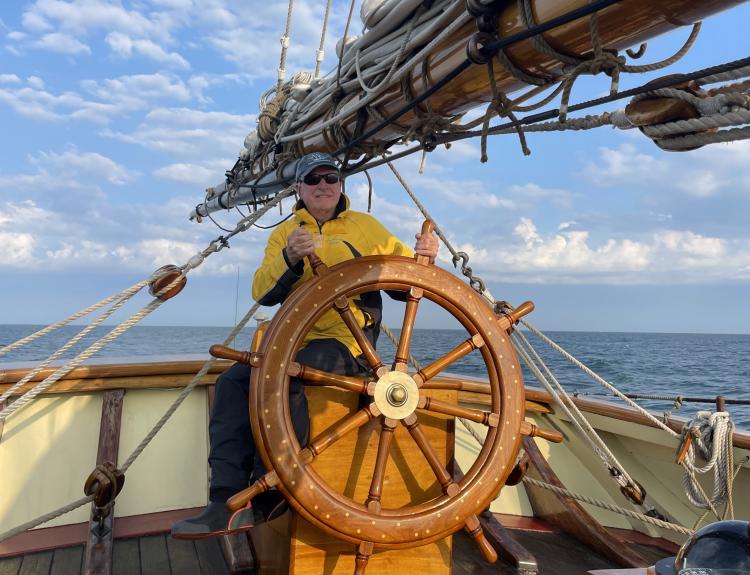
During the voyage, I stood watch with the B watch, from 4 to 8 o’clock every 12 hours. That meant checking sails and instruments, inspecting the bilges in all three compartments, keeping the log, and taking my turn at the helm. Steering for an hour at a time with nothing on the horizon but open water, while checking the compass and holding course, gives you a real appreciation for seamanship. We also saw one of the great rewards of being at sea: full moon, sunrise, and sunset over the water.
We made very good time under sail, at points reaching nine knots. Near Sandy Hook, New Jersey, the captain decided to stop the vessel offshore by putting her into a hove-to maneuver. That maneuver stops the ship and keeps it in place without using the anchor; the ‘anchoring’ occurs with use of the top square sail against the locked wheel. We remained there from 3 a.m. until 6 p.m. on Thursday, July 2. After getting underway again, we passed Coney Island, went under the Verrazzano-Narrows Bridge, and motored into New York Harbor after dark. Seeing the Statue of Liberty under a full moon, with the New York skyline lit up behind it, was something special. We docked around midnight at Pier 15 on the East River and finally got some rest.
The next day, July 3, after breakfast, we motored and sailed up the East River toward Hell Gate and back down toward Gravesend Bay, Brooklyn, as part of a parade of smaller American-built historic vessels. Ships like the Pride of Baltimore, the Lynx, and others could take part because they fit beneath the bridges connecting Manhattan, Brooklyn, and Queens, while the larger tall ships could not. For the rest of the day, we moved around New York Harbor near the Verrazzano, Battery Park, and partway up the Hudson, as far as the Coast Guard allowed.
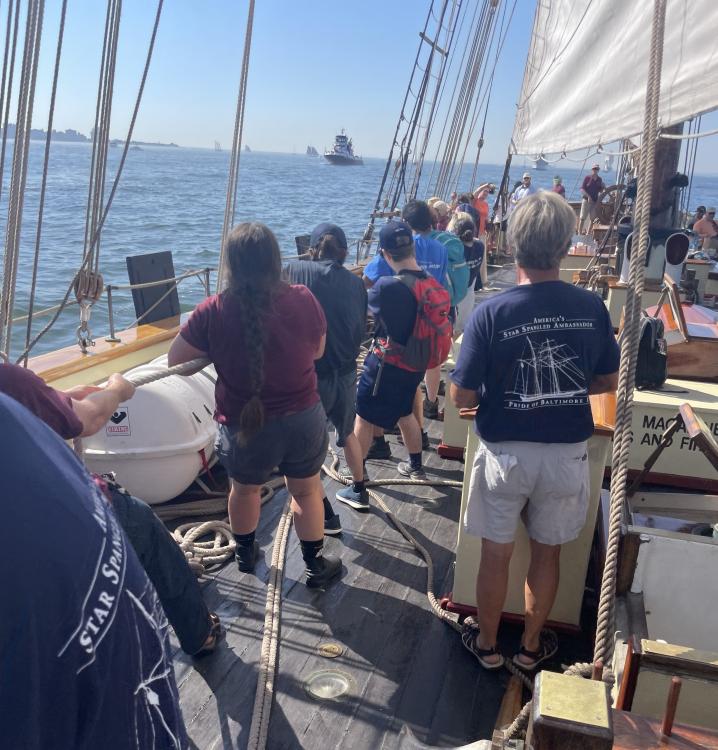
Then came the morning of July 4. We left the dock early, at 6 a.m., with several guests from Baltimore and Sea Scouts aboard. All ships rendezvoused near the Verrazzano Bridge before beginning the parade into New York and up the Hudson River toward the George Washington Bridge. At first, a flotilla of smaller craft accompanied us, though they were not allowed to continue up the river.
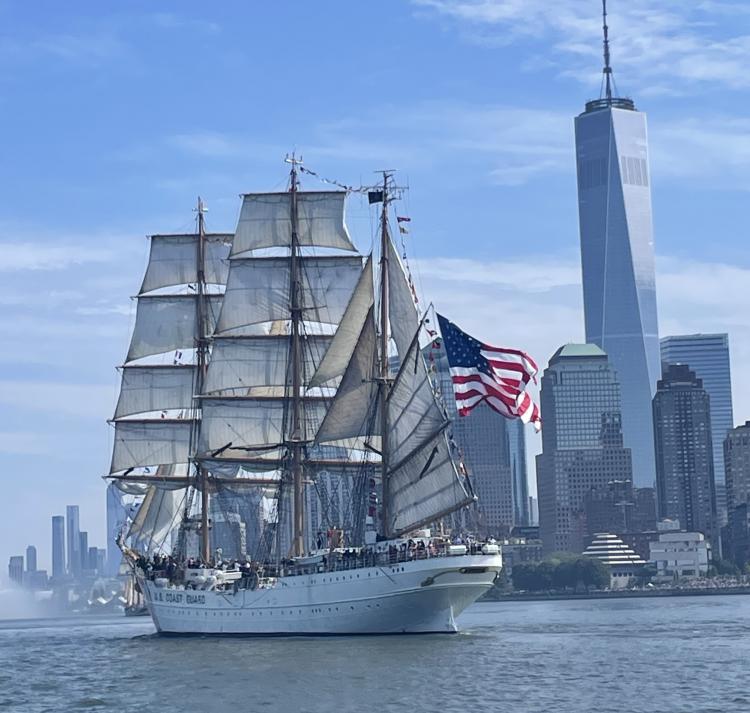
The Pride was close to the front of the line. Ahead of us was a New York City fireboat pumping water high into the air, followed by a Coast Guard security boat with weapons drawn. Also near the front were the Dutch vessel Oosterschelde and the U.S. Coast Guard Cutter Eagle. Then came the Pride of Baltimore and another historic vessel. From where I stood, I hardly knew where to look—forward, backward, toward the sky, or toward the shore. It was truly a show of epic proportions.
In all, there were 42 vessels. Among them were the Ara Libertad from Argentina, Belle Poule from France, Esmeralda from Chile, Juan Bautista Cambiaso from the Dominican Republic, Gorch Fock from Germany, Amerigo Vespucci from Italy, Dar Mlodziezy from Poland, Mircea from Romania, and Spain's training ship Juan Sebastian de Elcano, along with many more. To see these ships so close—some in front of us, some behind us—was unforgettable.
After the turn near the George Washington Bridge, we had the chance to enjoy the full procession of ships that had followed us upriver. The Queen Mary 2 was also in the harbor, adding to the scale of the occasion.
And then there was the air show. Military aircraft from several nations flew overhead in wave after wave. Many were from the United States, about 140 aircraft, led by the Blue Angels. There were F-35s, F-16s, F-18s, F-22s, B-29s, B-52s, helicopters, including Chinooks, Apaches, and Ospreys, as well as French and Canadian fighter jets, refueling aircraft, the Stealth Bomber B2-Spirit, and more.
Watching all of those aircraft flying in formation above the Pride of Baltimore on the Hudson River was almost overwhelming. They just kept coming. There was so much to take in that, at times, I was nearly speechless. Pictures probably describe it better than I can.
After the boat parade and air show, we returned to the dock around 1 p.m. to prepare for the rest of the day and evening. At 6 p.m., the Pride served as the venue for a catered reception for members of the Union Club, the historic New York social club founded in 1836. The guests showed a great deal of interest in the vessel and in her continuing mission.
That evening, the fireworks were every bit as big as you would expect for a Big Apple celebration of the nation's Big 250. From our berth at Pier 15, tied to a floating dock, we had a remarkable view. To the left was the Brooklyn Bridge, with fireworks seeming to pour over it like a waterfall. To the right were the larger bursts, stars, and booming shells lighting up the sky. It was a tremendous display of light and sound.
Security throughout the event was extremely tight. Around the pier areas, only people with credentials or tickets were allowed near the waterfront to watch the fireworks. Some of us went out Saturday afternoon, and when we came back, we had to pass through three checkpoints. The captain had told us this was not just a New York event, but a major federal event that had involved extensive planning and coordination for years.
All in all, it was a historic occasion for the country, and I am grateful that I was able to witness it and be part of it from so close aboard. ~By William Verbrugge
Learn more about the Pride of Baltimore II
Find more sailing stories


