What we've learned after a decade of tracking the numbers of dolphins and their seasonal patterns in the Chesapeake Bay
What has DolphinWatch learned after 10 years of watching and tracking dolphins in the Chesapeake Bay?
A decade ago, Helen Bailey, a scientist working at the Chesapeake Biological Laboratory (CBL) in Solomons, tested underwater microphones off the lab’s pier in Solomons before taking them offshore for offshore wind studies. “She consistently heard dolphin clicks and whistles,” said Dr. Tom Miller, CBL director at the time.
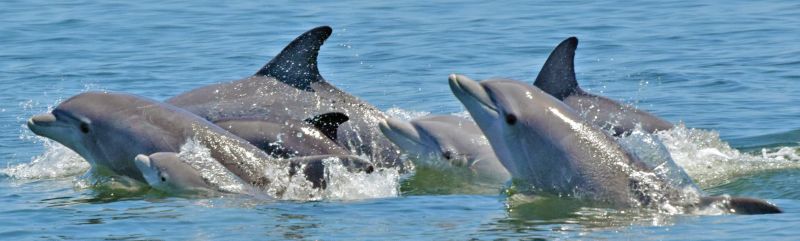
“She and I started talking about what we could do now that we knew dolphins were around. It was the perfect time to leverage those who were on the Bay or watching it from their decks to report to us when they saw dolphins.”
For the initial DolphinWatch app, support came from the Chesapeake Bay Trust. Dr. Miller, now a professor at the University of Maryland Center for Environmental Science (UMCES) whose work has been in fisheries, says, “I think we expected our friends to use it… we now have 20,000 registered users on the app and on Facebook. It is remarkable. We are so lucky that this has struck a chord.”
When asked if he’s seen changes in dolphin behavior since the program’s inception, Dr. Miller says, “I’m not sure we’ve seen distinct changes, but we have clearly demonstrated the seasonal shift in their distribution from when they’re restricted to the Lower Bay and beginning in April and May begin moving into the Bay. By [August], they are everywhere. They are as far up as Havre de Grace and the Susquehanna Flats, and way up the Potomac, until late August and early September when they begin a reverse movement.
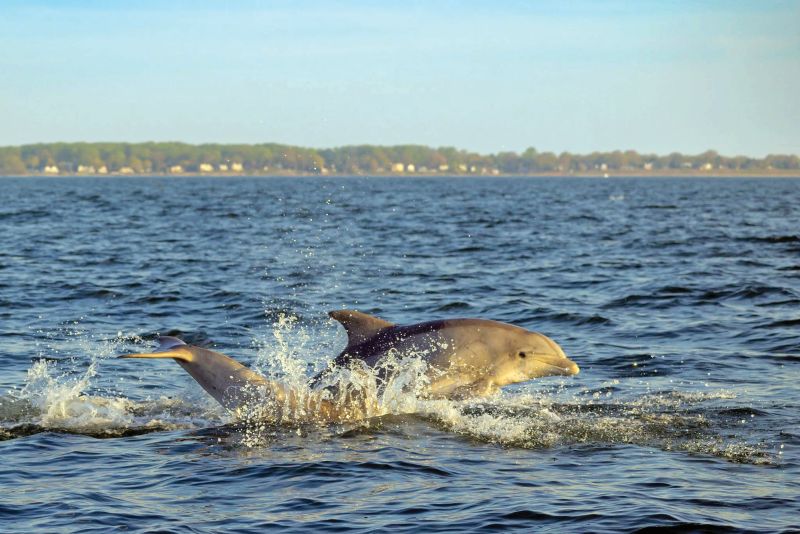
“We’re not sure what triggers this movement; that’s what we’re trying to understand. We have more data about dolphin behavior than we did back then. I don’t think we had any clear idea of their full coverage of their distribution, or that they go into water with such low salinity, and how comprehensive they are across the Bay during the summer months.”
The DolphinWatch team has been able to provide information to management of such projects as the Key Bridge disaster cleanup and whether or not “they’d have to take precautions before using explosives to remove the ship,” and the 301 Bridge construction over the Potomac.
“The information we’ve gathered is also used by the general public who want to go out and see dolphins,” Dr. Miller says. “By using the data from the app, they can design a trip with the aim of seeing dolphins where they’ve been recently sighted.”
All reported sightings are confirmed by the DolphinWatch team (especially those without photo or video support) to make sure the person reporting the sighting was sure it was a dolphin and not a cownosed ray or other sealife. This means they will not have the season’s stats until November or December. There are about 2000 sightings per year.
What should sailors know about dolphins and DolphinWatch? Dr. Miller says, “To recognize what an absolute joy and how special it is to see them in the wild. Celebrate that… The next thing is that there are guidelines on our app that help us watch dolphins responsibly, such as don’t chase them; don’t actively try to swim with them… Third, we encourage anyone out on the water to start reporting sightings to us. The more information we have, the more we can learn and protect them for future generations.”
Other tips from the DolphinWatch app: don’t feed or pet dolphins; keep 50 yards between yourself and the dolphins at all times; don’t try to initiate bow-riding behavior (if they do it on their own, maintain speed and direction); and notify authorities of stranded animals ((800) 628-9944 in Maryland, (757) 385-7575 in Virginia).
As long as the program is supported by community grants, Dr. Miller and his team hope to continue their work of answering questions about the numbers of dolphins, their seasonal patterns, and eventually, their genetic makeup.
It’s not too late in the season to download the Chesapeake DolphinWatch app from Google Play or the App Store and start reporting sightings. Learn more at chesapeakedolphinwatch.org.
~M.W.


