Safety Series Part: Preparation Tips From a First-Time Offshore Sailboat Racer
What does it take to make your boat and crew race-ready and as safe as possible for your first offshore race? For Annapolis sailor Bruce Irvin, it took more than a year of safety training, veteran racers’ guidance, an offshore coach, a dedicated crew, and many hours of hard work.
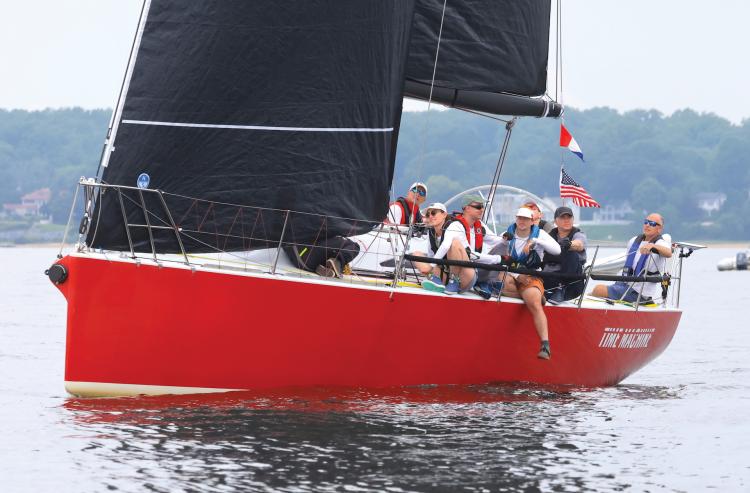
Irvin says, “Growing up, I thought it would be exciting to race offshore. Life moves fast, and the opportunity to try it out never arose. That aspiration never left, so after 10 great seasons racing Shamrock (J/30), I decided to make offshore racing a reality before too much more sand passed through the hourglass. This meant moving to an ocean-capable platform (the Corby 40 Time Machine). I was very fortunate to have a great crew ready to figure it out together.”
Last year’s Annapolis to Newport Race (A2N) was Irvin’s first offshore race: “I have done a lot of racing over the years, some ocean-adjacent, but I had zero miles of actual offshore experience. There was a lot to learn.”
He started with the two-day US Sailing Safety at Sea course (then) hosted at the Naval Academy. He says, “There is a huge advantage to climbing into a life raft for the first time, wearing foul weather gear and an inflated life vest, in the safety of an indoor pool. You quickly realize that it’s difficult and much better to do when your life is not on the line. The Safety at Sea course is the finest skills training available.”
Time Machine had an impressive racing history in Ireland, France, and the United Kingdom, including seven Fastnet Races, before being shipped to Annapolis in 2023.
The new owner said, “The boat needed all new wiring, battery management, instruments, and standing rigging to meet safety requirements. We also removed the rudder to inspect the finger bearings, replaced the steering quadrant chain, replaced the gooseneck and mainsheet attachment point, and rewired the mast. I am not sure how the Europeans managed their freshwater needs, but there were no water tanks or room for a main tank onboard. The solution was to strap a roto-molded 60-gallon tank over the keel in the middle of an already cramped main cabin. I had many concerns, but it performed flawlessly and functioned unintentionally as a leaning post for changing between watches.”
As with any reputable offshore race, A2N organizers offered detailed safety requirements and hosted in-depth seminars on safety, boat setup, and navigation. Irvin appreciated the generous sharing of knowledge and guidance of the race organizers and community.
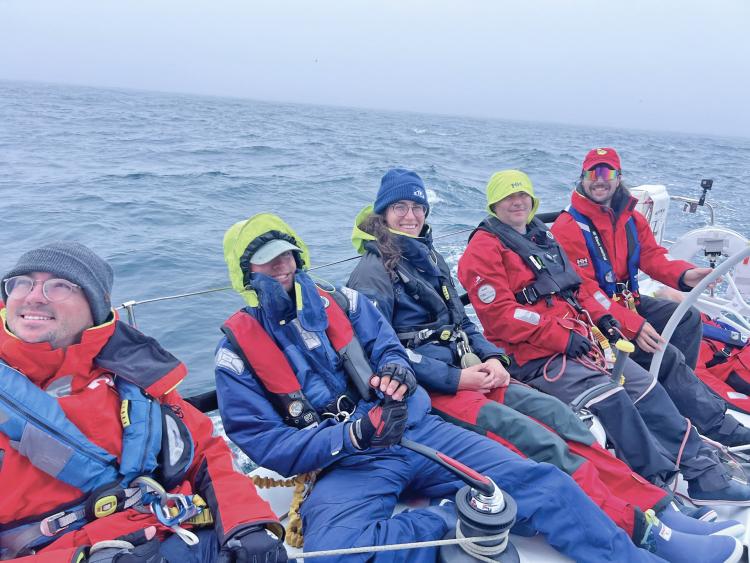
“The difficult part was managing all the tasks needed to bring the boat back into offshore readiness,” Irvin says. “For weekend racing, I am used to just needing good sails, a clean bottom, motivated crew, and a full cooler. Digesting the safety requirements for ocean racing was a great learning opportunity, and the race organizers helped to answer questions along the way. The original goal was to get the boat ready for the 2024 Annapolis to Bermuda Race (A2B) with about four months of preparation. Reality came quickly; it was clear we needed more time. It took us a full year and four months to get the boat and team ready to make the 2025 A2N race.”
The Time Machine crew invested their time and elbow grease: “The crew worked weekends and evenings to install the water system, construct a new companionway ladder, refit the pipe berths, make new floorboards, sand and paint the interior, replace blocks, clean/grease winches, and put together a first class medical kit.”
Of hiring professional racer and offshore coach Jahn Tihansky to train his crew on the water, Irvin says, “He arrived at the dock wearing what he would for the race along with his meticulously packed, small dry bag. Jahn walked us through what a pro sailor would bring and how to pack it. We took the boat out to do crew overboard/rescue training, headsail changes, reefing, rail sail-bagging, and heavy-air gybing drills over two days. Jahn’s training was invaluable to getting us well prepared on time. We also did an overnight practice race down the Bay to test the new systems, use the JetBoil stove, and run our watch schedule.”
When asked if during the race he ended up thankful for any of his safety equipment, Irvin explains, “At 3 a.m., in heavy fog, we happened to run into an unlighted deep water fishing rig and its pickup buoy. After speaking with the Coast Guard on the radio, I was grateful to use our on-deck emergency knife to cut the line wrapped around the keel and continue with the race.”
The skipper admits that they had overlooked careful meal planning and only had freeze dried packs and water on the list. He says, “Fortunately, crew member Rachel Kroll saw the gap and spent a few days prior to the race adding squeezables and snacks for each crew member for each meal, for each day, into named freezer bags. This made getting calories and liquids very easy and allowed crew members to eat on deck, reducing time spent below. Thanks to Rachel, everyone was hydrated and fed. Tired and hungry is a bad combo.”
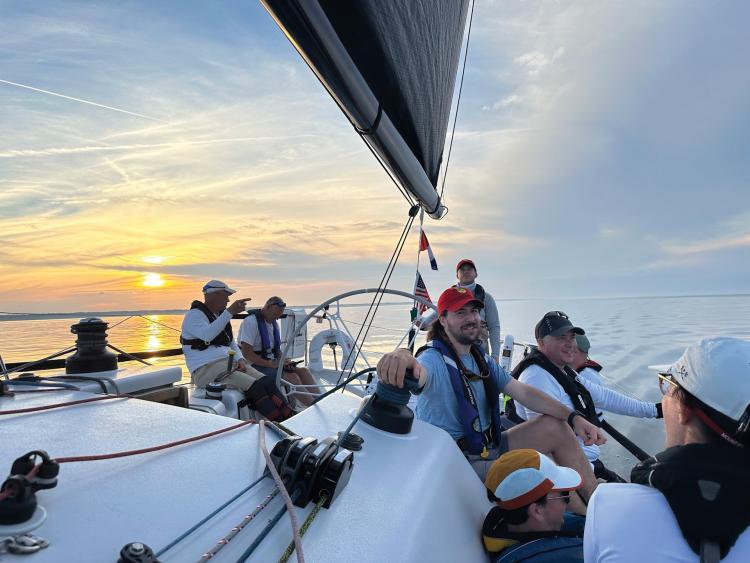
What will the crew do differently for their next offshore race? “Experiencing zero visibility in fog at night is not pleasant. I have been in very low visibility situations at night but never when the bow was obscured by dense fog. It produces a perfect sensory deprivation chamber. AIS is good, but there are many other hazards in the water besides ships and charted navigational aids. I quickly learned that radar is worth the extra weight and expense.”
Irvin’s Time Machine team has registered for the 2026 A2B Race, which begins June 5 off Annapolis. In addition to adding radar, he says, “Additional steps are an improved navigation station and adding a lower bobstay to the pole for strength. We will do another two days of on-the-water training and an overnight test race.”
When it comes to onboard safety, he adds, “It is remarkable to see how technology has made ocean racing safer and more accessible over the last few decades. We now have continuous satellite navigation, weather routing software, internet, and AIS. These advances, along with world-class training and race organizers who are dedicated to every crew member’s safety, are great testaments to our amazing sport.”
Find more sailing safety articles.


