Last year, in preparation for my first offshore regatta—the 2025 Annapolis to Newport Race (A2N) with Keith Cole’s J/124 Lucky Eights—Keith suggested that all crew take the two-day US Sailing Offshore Safety at Sea (SAS) seminar before the race. This was a welcome opportunity for me to refresh my knowledge of on-the-water safety while also learning more about the world of offshore racing. The course also gave me a lot to think about in the two months leading up to A2N.
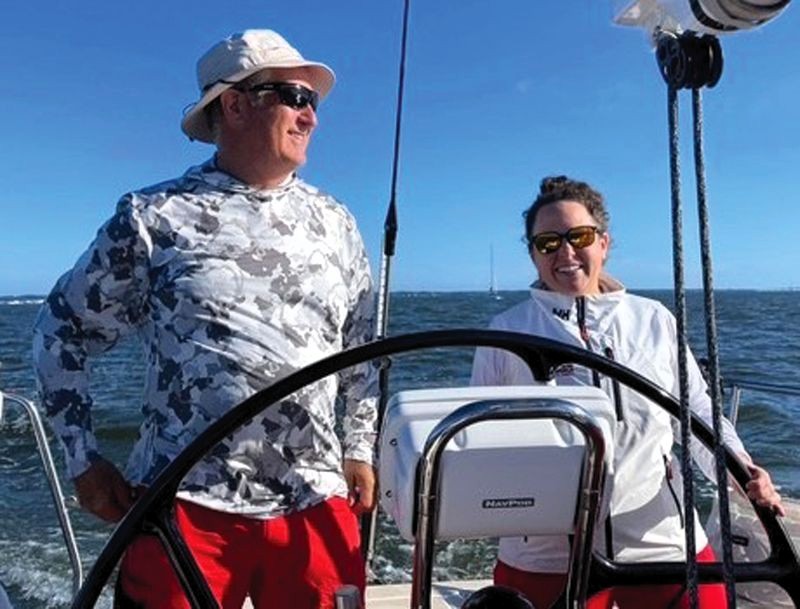
Growing up in a sailing family in Rhode Island, I’ve always been comfortable on or in the water, while simultaneously maintaining a healthy respect for water and water safety. I’ve raced on Narragansett Bay and the Chesapeake for years with various boats and captains and appreciate when skippers take the time to go over safety features on the boat before we leave the dock.
Safety At Sea: A welcome opportunity to learn about the world of offshore racing
The event took place in March, was sponsored by the Marine Trades Association of Maryland, and was held at the US Naval Academy. The first day was mostly lecture-hall instruction, and the second day was filled with practical hands-on activities. It is impossible to put into words all the things I learned (especially learning things I didn’t know that I didn’t know!), but I will attempt to group the major items I learned into five categories.
1. Crew responsibilities and seamanship
As crew, we sailors often step aboard a boat assuming that the owner/skipper knows everything needed tohave a safe, successful trip. At SAS, the instructors drilled into our heads that everyone aboard should know how to do almost everything on the boat, especially in an offshore situation. For example, all crew should know the general location of the boat and be able to read charts and use the navigation equipment. Everyone should know where the safety equipment is, how to operate the radio and other communication devices, where the EPIRB is and how to activate it, and how to call the Coast Guard and know what information to share with them.
Although severe damage to a boat is unlikely, it was stressed that all onboard should understand damage control, how to jury-rig a boat repair until help arrives, and how to launch the vessel’s life raft. In other words, as the instructors reiterated, as the instructors reiterated, “You can’t buy safety.” Everyone aboard needs to understand the communication systems and seamanship.
2. Real life stories and lessons learned
Early on the first day, Mary Martin and Eric Irwin, co-owners of the J/122 Alliance, detailed their experience of losing their boat due to catastrophic flooding after colliding with an unidentified object at about 3 a.m. while 260 miles offshore during the 2024 Newport to Bermuda Race. Thankfully, after a competitor boat rescued all crew from Alliance’s life raft, they arrived safely in Bermuda. However, their firsthand account was very impactful and set the stage for the rest of the seminar.
Martin and Irwin emphasized the importance of preparing for the unexpected, both in terms of the crew and the boat. They especially stressed the importance of clear and calm command communications both internally to the crew and externally to others (such as the Coast Guard and other boats in the vicinity). Their presentation encouraged all offshore sailors to continually learn, take courses, ask questions, do emergency training drills, and never become complacent.
3. Communications and a rescue demonstration
Throughout the two-day course, the importance of communication was continuously stressed. Instructors repeatedly referred to numerous types of communication devices that we might use while underway—EPIRB, VHF-DSC, PLB, AIS-MOB, HF, and others. We even learned how to ensure that at night we would be ‘night vision goggle visible’ to the Coast Guard, who would be wearing night
vision goggles.
In addition to gaining familiarity with the various communication devices and how to use them, SAS gave me a better understanding of how to execute optimal information flow in an emergency. For example, calling someone on land for help is less efficient than calling the Coast Guard directly and calling for help before a situation becomes dire is more important when offshore.
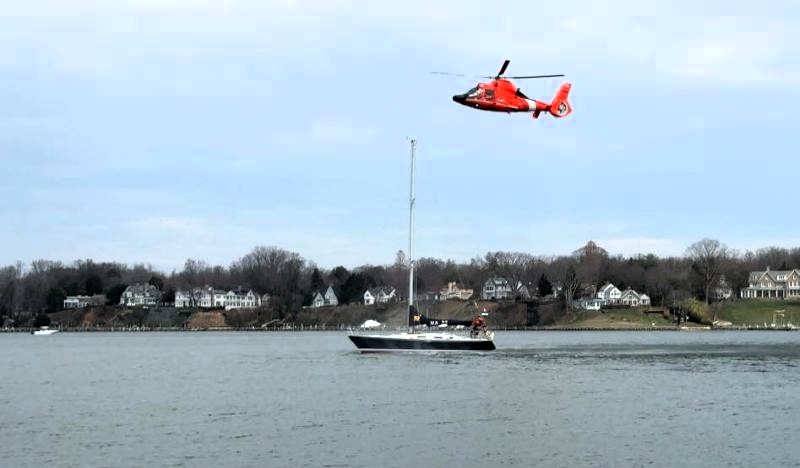
Fortunately, the weather cooperated, and we were lucky to witness an impressive on-water MOB rescue demonstration on the Severn River. From the academy shoreline we watched as a US Naval Academy keelboat crewed by midshipmen was met by a US Coast Guard helicopter and rescue team. Watching the dramatic operation unfold in real time provided a better understanding of the timing, logistics, and process for air rescue at sea.
4. Hands-On activities
On the second day we rotated as a group through four sessions: communications, pyrotechnics/fire, damage control/jury rigging, and swimming pool life raft training. These rotations helped us apply much of what we learned in the previous day’s lectures to ‘real life’ scenarios. I found each rotation to be incredibly helpful as I prepared my lists of things to consider for my own A2N race.
The damage control and jury-rigging session stressed problem solving strategies and the importance of backup strategies for any chosen solution. For example, in the event of water inflow, we learned not only how to plug holes with materials that we might find onboard, but the instructors also emphasized strategizing on how to reinforce the plug in multiple ways to increase the likelihood of success.
Beyond our own safety, we were asked to consider what might happen if we were to give assistance to another boat. Most offshore sailors bring tools for repairs to their own vessel, but we were asked to consider what other tools might be needed for an emergency on someone else’s boat. Similarly, what would happen if we took on crew that were abandoning their boat? Would we have enough extra water and rations for everyone?
One of the most well-known sessions of SAS is the life raft in the pool rotation. Participants jump in a swimming pool wearing full foul weather gear and lifejackets. We practiced survival formations and strategies for getting into the life raft. One thing that stuck out to me was how important it is to get the strongest person into the life raft first, so that they can help sick, wounded, and other crew into the raft.
5. Connecting with the women who sail community
After years and years of sailing with mostly men, I was encouraged to see how many women attended the SAS course. The women I met were each taking the course for a different reason, but the common thread was that we all wanted to be more competent and confident when underway and carry our fair share of responsibility for overall self and crew safety.
During the hands-on activities, I noticed that the women in my group were incredibly supportive of each other and worked well in team dynamics. When it came to problem solving, we valued everyone’s input and allowed all to equally contribute to the solution. That’s not to say that some boats with men aren’t like this. They are. But to me, a majority female dynamic just feels more collaborative, encouraging, and supportive, and that was a really welcoming aspect of the SAS experience.
by Michelle Greenhalgh

About the Author: Michelle Greenhalgh lives in Annapolis, MD with her husband and two rescue dogs. She balances a high-intensity career in public policy with a "casually serious" approach to racing after work and on the weekends. Michelle has raced regularly with Lucky Eights (J-124), Blinding Fury (Shock 35) and on various Fleet 3 J/105s for the past nine years. Though her first offshore regatta didn't turn out as planned (Lucky Eights had to retire due to mechanical a mechanical failure), she is looking forward to combining her Safety at Sea training and her experience gained over the first few days of the 2025 A2N race to another offshore regatta in 2026.
2026 Safety at Sea Seminars on the Chesapeake:
1. March 28-9 at the Maritime Institute of Technology & Graduate Studies, adjacent to Baltimore Washington International Airport, sponsored by the Marine Trades Association of Maryland.
2. April 18 at the Mariner's Museum and Park, Newport News, VA.


