When your sail exceeds your comfort zone, yet is not deep into the ocean, here are some coastal sailing safety considerations for your boat.
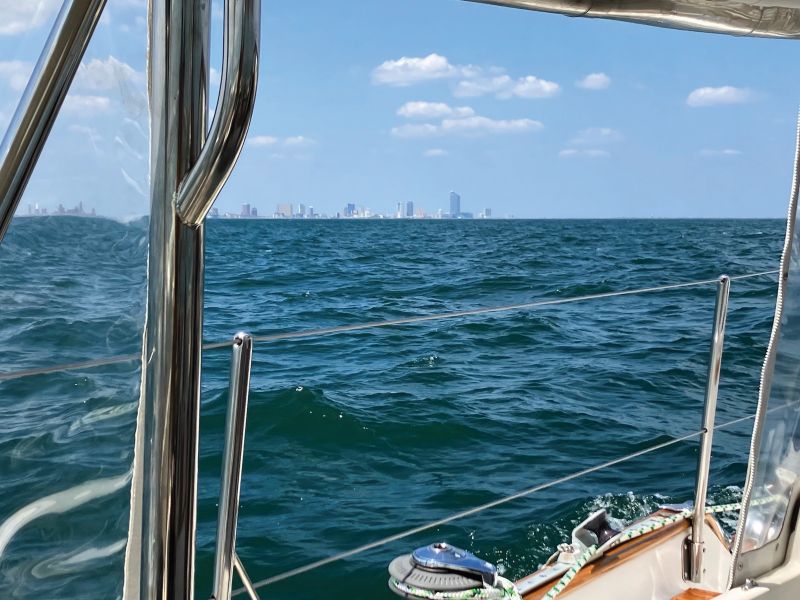
Safety considerations for coastal sailing
Three years ago, we were preparing for several months of coastal cruising to Maine over the summer, continuing to the Bahamas for the winter. During the prior seven years, we had cruised extensively on Belle Bateau throughout the Chesapeake Bay region, including the Delaware Bay to Cape May and Philadelphia. This meant that we were always within reach of land and land-based facilities in less than two hours.
However, despite carrying all the USCG-required safety equipment, we felt that coastal cruising required a different tactic to ensure our boat was appropriately equipped for safety. As we began planning our route to Maine, we anticipated staying within a few miles of the Atlantic coastline. But we would still be in the ocean, not familiar bays. We would not have the ability to tuck into a cove if a squall developed. We would be much further from emergency response teams in case of a medical crisis or if our boat were suddenly taking on water.
Every sailor needs to decide their own risk tolerance and make choices about safety that work for their crew and their vessel. For us, we chose a path that added more safety precautions to our Chesapeake norm but stopped short of what offshore racers might do (see “Safety Series Part 1, Equipping Your Boat for Ocean Racing,” SpinSheet April 2026). Perhaps our coastal safety checklist can influence your own decisions when planning a similar adventure.
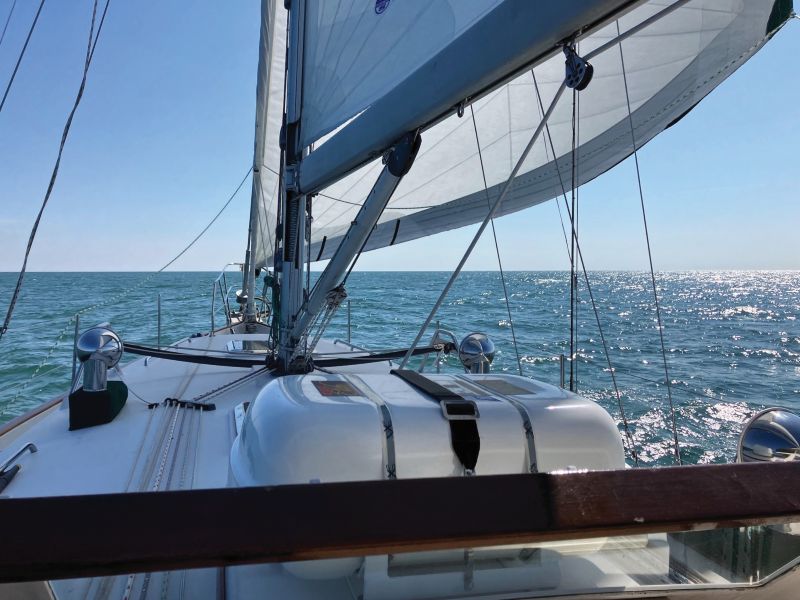
Safety maintenance and upgrades
With an anticipated departure date of early June, we began maintenance and upgrades over the winter months while Belle Bateau was on the hard. We contracted several services to be performed by local experts, including professional diesel engine service and rigging. We typically do a lot of DIY, and that winter into spring was no exception. My husband and I created a five-page checklist with our assigned tasks and kept the document current in a shared folder. Belle Bateau was splashed in early May, one month before we planned to depart.
Our checklists, created with the understanding that we would be distant from familiar and reliable mechanics, included the following:
- Inspect, maintain, upgrade, and/or service all systems, including diesel engine, standing rigging, running rigging, navigation lights, fog horn, navigation equipment and charts, AIS, radar, and sails. We decided to replace our standing rigging, and two-thirds of our running rigging. We had our sails washed and repaired, painted our hull, and prepared our thrusters and prop to endure the harsher saltwater climate.
- Test all boat systems. We took a few shakedown cruises in the Chesapeake to ensure that all systems were working properly. We anticipated fog in Maine, so we tested our automated fog horn and practiced sailing in limited visibility using radar. In retrospect, we should have done a shakedown with our dinghy outboard, which we ended up replacing in Mystic a few weeks into our trip. Don’t forget to test your dinghy, too!
- Inventory and purchase or upgrade safety equipment as per your risk tolerance, including EPIRB, personal locator beacons (PLB), ditch bag, personal floatation devices (PFD) for coastal sailing, tethers, jack lines, VHF with DSC function, and a life raft. We had invested in a life raft and an EPIRB for our coastal cruising adventure to Florida seven years prior. We also assembled a ditch bag, which we had not felt the need for on the Chesapeake. We inventoried our PFDs and confirmed that two of our four inflatable Type Vs were rated for coastal sailing, and we kept six additional ones for guests. We inspected our fire extinguishers and electronic flares and confirmed we had all the necessary USCG equipment onboard.
- Inventory and replenish spare parts. It’s always a challenge to determine what spare parts to carry. Just remember that you may need to make repairs while underway before arriving at the next coastal town, which may be a bit farther than well-stocked towns that ring the Chesapeake Bay.
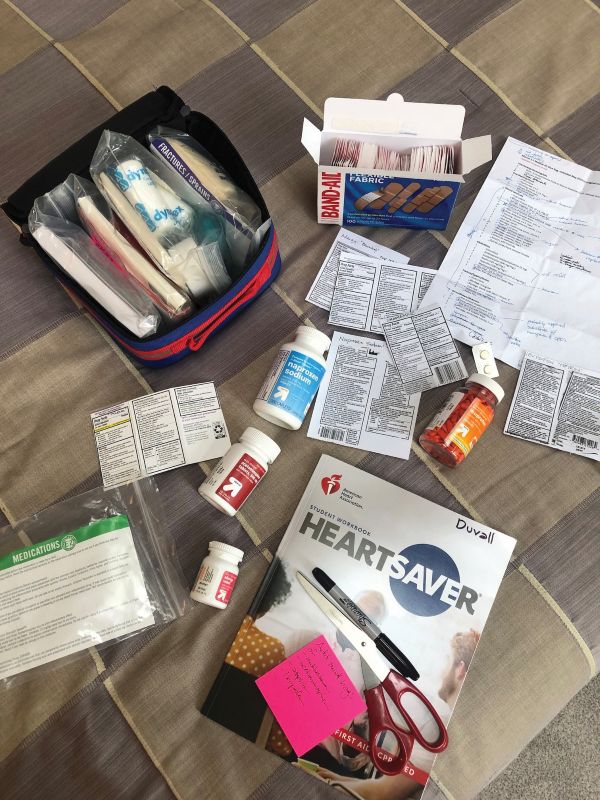
- Inventory and replenish medical kits. The farther one gets from land, the longer it takes for emergency responders to reach a boat with the equipment that might be needed. For our coastal journey, we kept our purchased medical kit but inventoried and replenished its contents, supplementing with additional supplies recommended by our personal physicians. According to Captain Alan Karpas, Safety Institute of Maryland, “When you are sailing offshore but in sight of land and experience a medical emergency, you can anticipate the Coast Guard to reach your vessel, remove the injured party, and get them into the hands of the medical personnel in about 1.75 hours. Captains should have first aid and CPR/AED training as well as an appropriate first aid kit to treat an injured crew or passenger. I recommend the Adventure Medical Marine Series Medical Kit #350. It is described as a boat first aid kit for six people two hours from care. This first aid kit, or an equivalent, is widely available. If a boater experiences cardiac arrest, their only hope for survival is by having an AED onboard the vessel.”
Recommended, though not always heeded
Before embarking on a coastal adventure, consider these safety suggestions that sailors often hear but may not always heed:
- Request a free Vessel Safety Check. To help make boating as safe as possible, both the U.S. Coast Guard Auxiliary and the United States Power Squadrons have certified vessel examiners who will perform a free Vessel Safety Check (VSC) at your recreational boat. There is no fee for this service, and there are no consequences if your vessel doesn’t pass.
- Wear your PFD all the time. I confess: I don’t wear my PFD all the time in the Chesapeake, despite it being a comfortable Type V. I do always wear my PFD along the coast and on the open ocean. A few statistics and phrases I read on uscgboating.org were quite persuasive: “Skydivers wear their parachutes... Football players wear their helmets... Drivers wear their seat belts... Responsible boaters wear their lifejackets!” “The best USCG-approved lifejacket or buoyancy aid is the one you will wear.” “A wearable PFD can save your life, but only when you wear it.”
- File a float plan. It’s important to let a friend or family member know when and where you are sailing and that they expect to be notified when you have arrived. Even with today’s tracking devices, it is still advisable to file a float plan. Trackers don’t always update in real time, and they can glitch. The USCG Auxiliary provides an easy-to-use fillable float plan: floatplancentral.cgaux.org/download/USCGFloatPlan.pdf.
Equip your mindset, too
Let’s face it: the most important safety feature on your vessel is your brain. You can install an impressive array of safety equipment and understand the rules of the road, but you must make prudent and seaworthy decisions to keep yourself and your boat safe. We follow a safety-focused mindset that enforces two non-negotiable agreements: We don’t allow anyone to drink alcohol until our boat is safely docked or anchored, and we don’t sail to a schedule, avoiding sailing into bad weather to meet up with friends.
Nothing ruins a trip like a serious accident, medical emergency, or mechanical breakdown. Let’s stay safe and enjoy our time on the water.
by Capt. Cheryl Duvall


